Most teams track one conversion: the sale, the signup, the demo request. Everything else is invisible. The problem is that the big conversion is rare. If only 2% of visitors convert, you are flying blind about what the other 98% are doing on the way to that decision, and you have almost no data to optimize with.
Micro-conversions fill that gap. They are the small, intermediate actions a visitor takes before the main event: watching a product video, viewing pricing, downloading a guide, adding an item to cart. Track them well and you turn a sparse, noisy signal into a rich map of intent.
After years of building tracking plans, I have learned that the teams who measure micro-conversions optimize faster and argue less. This guide covers what micro-conversions are, which ones actually predict revenue, and how to set them up without drowning in noise. It is a companion to the broader conversion funnel optimization playbook.
Macro vs Micro Conversions
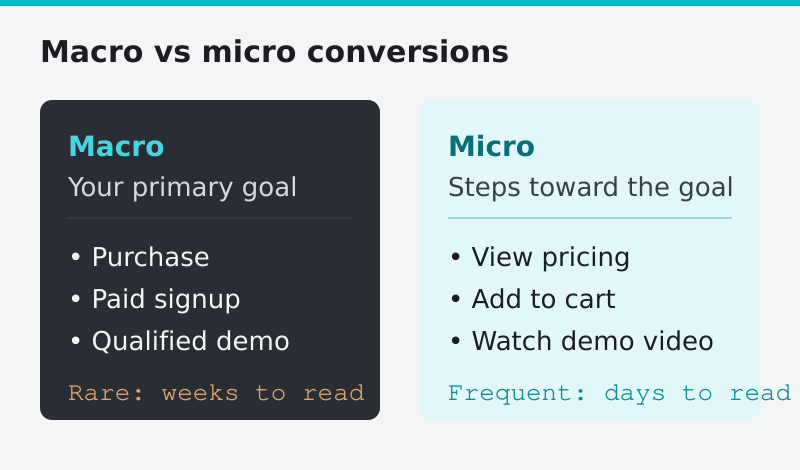
A macro-conversion is your primary business goal. For an ecommerce store it is a purchase. For a SaaS product it is a paid signup or a qualified demo. For a content site it might be a newsletter subscription that feeds your sales pipeline.
A micro-conversion is any meaningful step that signals progress toward that goal. It is not the destination, but it shows the visitor is moving in the right direction.
The distinction matters because macro-conversions are too rare to optimize against directly. If you change a landing page and your purchase rate is 1.5%, you might need weeks of traffic before you can tell whether the change helped. But the micro-conversions feeding that purchase happen far more often, so you get a readable signal in days instead of weeks.
The Two Types of Micro-Conversions
I split micro-conversions into two buckets, and keeping them separate prevents a lot of confused analysis.
- Process milestones are steps inside a defined journey. Reaching the cart, completing step two of a four-step signup, or starting a free trial are all process milestones. They live on the direct path to conversion.
- Secondary actions are signals of interest that sit off the main path. Watching a demo video, reading three blog posts, sharing a page, or downloading a comparison sheet all suggest engagement without being part of the checkout flow.
Process milestones tell you where people drop off. Secondary actions tell you who is warming up. You want both, and you should report them differently.
Which Micro-Conversions Actually Predict Revenue
Here is the trap: it is easy to track fifty micro-conversions and learn nothing. Volume of events is not insight. The goal is to find the handful of actions that genuinely correlate with the macro-conversion.
The way to find them is to look backward. Take the people who converted and ask what they did before converting. Then take the people who did not convert and ask the same. The micro-conversions that show up far more often in the converting group are your predictive events.
On one SaaS product I worked on, we tested a dozen candidate micro-conversions. Most were noise. But users who viewed the pricing page and started a trial within the same session converted at roughly four times the rate of everyone else. That single combination became the event we optimized the whole top of funnel around.
Common micro-conversions worth testing as predictors:
| Micro-conversion | Signal strength | Best for |
|---|---|---|
| Pricing page view | High | SaaS, B2B |
| Add to cart | High | Ecommerce |
| Free tool or calculator used | High | SaaS, lead gen |
| Demo video watched to 75% | Medium | SaaS, B2B |
| Newsletter signup | Medium | Content, lead gen |
| Multiple sessions in a week | Medium | All |
| Blog post read | Low | Top of funnel only |
Treat this table as a starting hypothesis, not gospel. The signal strength of any micro-conversion depends on your audience, and the only way to confirm it is to check the correlation in your own data.
How to Set Up Micro-Conversion Tracking
You do not need new tools. Google Analytics 4 and a tag manager handle nearly all of this. The work is mostly deciding what to track and naming it consistently.
Start by listing your funnel out loud. Write down every step a visitor takes from landing to converting. Each step is a candidate event. For an ecommerce flow that might be: view product, add to cart, begin checkout, add shipping, add payment, purchase.
Fire an event at each step. In GA4 these become custom events. Use clear, consistent names: view_pricing, start_trial, add_to_cart. Sloppy naming is the number-one reason micro-conversion data becomes unusable six months later.
Mark the important ones as key events. In GA4 you can flag any event as a key event (the new term for conversions). Do not mark all of them. Reserve key-event status for the micro-conversions you have confirmed are predictive, so your reports stay focused.
Add scroll and engagement triggers carefully. A tag manager can fire events on scroll depth, video progress, and time on page. These are useful for secondary-action signals, but they generate a lot of volume. Only keep the ones tied to a real decision point.
Avoiding the Vanity Event Trap
The fastest way to ruin a micro-conversion setup is to celebrate events that do not lead anywhere. “Scrolled 50% of the page” feels like engagement, but if scrollers convert at the same rate as non-scrollers, the event is decoration.
My rule: every micro-conversion you report on must pass a correlation check. If converting users and non-converting users do the action at the same rate, retire it from your dashboard. Keep firing the event if you want raw data, but stop treating it as a success metric.
This discipline keeps your reports honest. A dashboard with five predictive micro-conversions drives better decisions than one with thirty vanity events that nobody trusts.
Using Micro-Conversions to Optimize
Once you have a clean set of predictive micro-conversions, three optimization moves open up.
Find the leak. If 60% of visitors add to cart but only 15% begin checkout, your problem is between those two steps, not at the headline. Micro-conversions let you point at the exact stage that is failing instead of guessing.
Run faster experiments. Because micro-conversions happen more often than purchases, you can test changes against them and get a readable result in a fraction of the time. Just confirm the micro-conversion truly predicts the macro one before you trust it as a proxy.
Score and route leads. Stack your predictive micro-conversions into a simple lead score. A visitor who viewed pricing, used the calculator, and returned twice is worth a sales touch. One who read a single blog post is not. The same logic works after the sale: a customer who stops firing the events they used to fire is giving you one of the early churn warning signals a risk score can be built on. This is the connective tissue between your traffic analysis and your actual pipeline.
A Practical Starting Point
If this feels like a lot, start small. Pick three micro-conversions you suspect matter, set them up cleanly, and watch them for a month. Check whether they correlate with your real conversions. Keep the ones that do, cut the ones that do not, and add a few more.
Within a couple of cycles you will have a short, trusted list of intermediate signals that tell you how visitors move toward a sale long before they make it. That visibility is the whole reason micro-conversions are worth the effort. They turn a rare event you cannot optimize into a stream of signals you can act on every week.
FAQ
What is a micro-conversion?
A micro-conversion is a small, intermediate action a visitor takes on the way to your main goal, such as viewing a pricing page, adding an item to cart, or watching a demo video. It is not the final sale, but it signals progress toward it and happens far more often, which makes it useful for optimization.
Should I treat every micro-conversion as a goal?
No. Only treat micro-conversions as goals once you have confirmed they correlate with your actual revenue. Tracking events that do not predict conversion clutters your reports and leads to optimizing for activity that does not matter. Keep firing the events if you want the raw data, but report only the predictive ones.
How do micro-conversions help me optimize faster?
Macro-conversions like purchases are rare, so testing against them takes weeks to reach significance. Micro-conversions happen far more often, so you get a readable result in days. As long as a micro-conversion genuinely predicts the macro one, you can use it as a faster proxy for experiments.
How many micro-conversions should I track?
Track as many as you like in the background, but report on only the handful that have passed a correlation check against your real conversions. A focused set of five predictive signals drives better decisions than thirty vanity events nobody trusts.