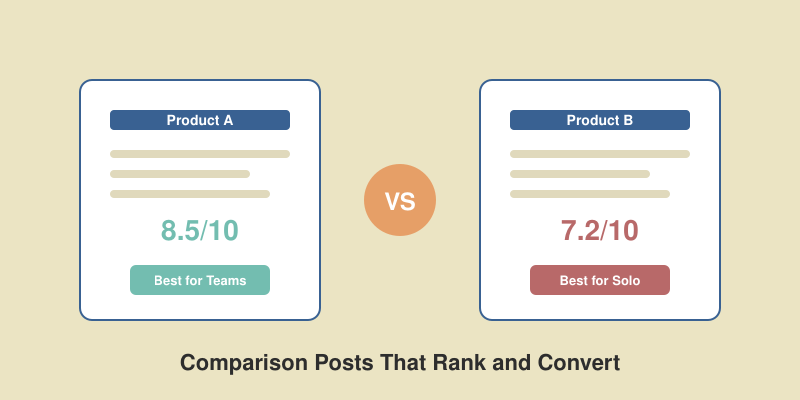
How to Write Product Comparison Posts That Rank and Convert

Someone types “Mailchimp vs ConvertKit” into Google. They’re not browsing. They’re not researching a broad topic. They’re standing at a decision point with a credit card nearby, trying to figure out which tool deserves their money.

That’s why product comparison posts are the highest-converting content format in SaaS and marketing niches. I’ve written over 40 comparison posts across SaaS and marketing verticals, and they consistently outperform every other content type — by a wide margin. One comparison post I published generated 3x more affiliate revenue than a pillar guide with 10x the traffic.

But most comparison posts are terrible. They’re either thinly disguised affiliate pitches, vague “it depends” non-answers, or bloated feature dumps that help nobody. The posts that actually rank and convert follow a specific structure.

In this guide, I’ll walk you through the exact process I use to write comparison posts that capture high-intent search traffic and turn readers into buyers.

Why Comparison Posts Convert Better Than Reviews

Single product reviews attract people who are still exploring. Comparison posts attract people who have narrowed their choices to two or three options. That’s a fundamentally different mindset — and it shows in the data.

In my experience, comparison post readers convert at 4-7%, while general review readers hover around 1-2%. The reason is simple: comparison searchers have already done their initial research. They know what category of tool they need. They just need someone to help them make the final call.

“Vs” keywords also tend to be less competitive than broad product review terms. Try ranking for “best email marketing tools” against enterprise publishers with massive domain authority. Now try “Mailchimp vs ConvertKit for small business” — suddenly you’re competing in a much more winnable space.

There’s a compounding benefit too. Every SaaS niche has dozens of possible head-to-head matchups. If there are 8 tools in a category, that’s 28 unique comparison pairs. Each one is a separate ranking opportunity with high purchase intent.

Step 1 — Find Comparison Keywords Worth Targeting

Not every “vs” keyword is worth writing about. You need search volume, clear intent, and a realistic chance of ranking. Here’s how I evaluate comparison keyword opportunities.

Start with your niche’s tool landscape. List every product in the category. Then map out the logical comparisons — people compare tools at similar price points, with overlapping features, or that serve the same audience segment.

Check actual search volume. Use Google Keyword Planner, Ahrefs, or even Google Suggest. Type “[tool name] vs” and see what autocomplete suggests. If Google suggests it, people are searching for it. I covered keyword research fundamentals in my guide to keyword research from zero to content strategy — the same principles apply here.

Prioritize by commercial value. A comparison between two $200/month enterprise tools is worth more than two free tools, even if the free tool comparison gets more searches. Factor in affiliate commission rates, conversion likelihood, and audience quality.

Look for content gaps. Search for each comparison keyword. If the top results are outdated, thin, or from low-authority sites, that’s your opportunity. I’ve ranked comparison posts on page one within weeks when the existing content was clearly stale.

Step 2 — Structure Your Post for Scanners and Readers

Comparison post structure showing six sections from quick verdict to FAQ, with indicators for where scanners stop and readers go deeper

Comparison post readers come in two modes. Scanners want the answer in 30 seconds. Readers want the full analysis. Your structure needs to serve both.

Lead with the verdict. Put your recommendation in the first 100 words. “If you need X, choose Product A. If you need Y, go with Product B.” This sounds counterintuitive — why would someone keep reading if you give away the answer? Because the quick answer builds trust, and most readers still want to understand why.

Follow with a summary table. A side-by-side comparison table lets scanners get the key differences in seconds. Cover pricing, standout features, best-for use cases, and your rating. Keep it to 5-7 rows maximum.

Then go deep on each product. After the table, break down each tool individually. Cover strengths, weaknesses, pricing details, and who it’s ideal for. Use H2 or H3 headings that include the product names — these help with SEO and scannability.

End with a clear recommendation section. Repeat your verdict with more context. Frame it as “Choose A if…” and “Choose B if…” scenarios. This is where most of your conversions happen.

Step 3 — Build Comparison Tables That Actually Help

Comparison table best practices showing a sample feature table alongside do-this and avoid-this tips for building effective tables

The comparison table is the most important element in your post. It’s what scanners read, what Google often pulls for featured snippets, and what readers reference when making their decision. Get this right and everything else is easier.

Use specific numbers, not vague ratings. “50+ integrations” is useful. “Good integration support” is not. “$29/month for 1,000 contacts” beats “affordable pricing.” Every row in your table should contain concrete, verifiable information.

Limit your table to 5-7 key features. I’ve tested this extensively. Tables with more than 7 rows cause decision fatigue. Readers glaze over and the table loses its power as a quick-reference tool. Pick the features that actually matter for the buying decision.

Highlight the winner in each row. Use color coding, bold text, or a simple checkmark to show which product wins on each criterion. This visual shorthand helps readers process the comparison faster. Just be honest — if Product B wins on integrations, say so, even if you’re recommending Product A overall.

Always include pricing. Price is the single most-compared factor in any product decision. If you leave it out of your table, readers will leave your page to find it elsewhere. Include the most relevant pricing tier for your audience.

Make it mobile-friendly. Over half your comparison traffic will come from mobile devices. Test your table on a phone. If readers need to scroll horizontally, simplify it. Two-column tables (Feature | Product A | Product B) work best on mobile.

Step 4 — Write Honest Pros and Cons (Trust Sells)

Here’s where most comparison posts fail. The writer has an affiliate relationship with one product, so they soften the cons and inflate the pros. Readers aren’t stupid — they can feel the bias, and they bounce.

I learned this the hard way. Early in my career, I wrote a comparison post that was essentially a sales page for the product with the higher affiliate commission. It ranked briefly, but the bounce rate was over 80% and it dropped off page one within two months. Google’s helpful content signals picked up that readers weren’t satisfied.

Every product gets real weaknesses. Not “the interface could be slightly more intuitive.” Real weaknesses like “the reporting dashboard crashes when you have more than 10,000 contacts” or “customer support takes 48+ hours to respond.” If you’ve actually used the products, you know these pain points exist.

Frame weaknesses constructively. Being honest doesn’t mean being harsh. “ConvertKit lacks e-commerce automation — if you run an online store, this is a dealbreaker” is honest and helpful. It tells the reader exactly who should avoid this tool and why.

Include personal experience markers. “In my testing…” or “After using this for 6 months…” signals real experience. Google’s E-E-A-T guidelines explicitly reward first-hand experience, and readers trust writers who have actually used what they’re reviewing.

The paradox of honest comparison content is that admitting flaws increases conversions. When a reader trusts your negative assessments, they trust your positive ones too. I’ve seen comparison posts with brutally honest cons sections convert at 2x the rate of puff pieces.

Step 5 — Optimize for Featured Snippets

Featured snippet optimization showing a search result for a vs query with tips for answer-first writing, heading structure, and table usage

Comparison queries frequently trigger featured snippets — those answer boxes that appear above the regular search results. Winning the featured snippet for a high-intent comparison keyword can double or triple your click-through rate.

Answer the core question in 40-60 words. Right after your H1 or in your introduction, include a concise paragraph that directly answers “[Product A] vs [Product B].” Google often pulls this for the snippet. Write it as if you’re giving a friend a quick recommendation over text.

Use H2 headings that match search queries. If people search “Mailchimp vs ConvertKit pricing,” make one of your H2s exactly that phrase (or close to it). Google matches heading text to queries when selecting snippet content.

Format for extraction. Use HTML tables, bullet points, and numbered lists. Google’s snippet algorithm favors structured content that can be cleanly extracted and displayed. A well-formatted comparison table is snippet bait.

Target multiple snippet opportunities. A single comparison post can rank for several featured snippets: the main “vs” query, specific feature comparisons, pricing comparisons, and “which is better for X” variations. Structure your content so each H2 section could stand alone as a snippet answer.

Step 6 — Add a Clear Recommendation

This is where you earn the conversion. After all the analysis, tables, and pros and cons, tell the reader what to do. Not “it depends on your needs” — give them a specific, opinionated recommendation segmented by use case.

Use a decision framework. “Choose Product A if you…” followed by 2-3 specific scenarios. “Choose Product B if you…” with another 2-3 scenarios. This format respects that different readers have different needs while still being decisively helpful.

Include a “best overall” pick. Even with segmented recommendations, most readers want to know which one you’d personally choose. State it clearly: “If I were starting fresh today, I’d go with Product A because…” This personal stake makes your recommendation feel authentic.

Make the next step obvious. Whether it’s a link to sign up for a free trial, a link to your detailed review, or a button to check current pricing — make the action path frictionless. I’ve found that placing a single, clear CTA immediately after the recommendation outperforms multiple CTAs scattered throughout the post.

Once your comparison post is published, don’t let it sit in isolation. Build it into your content strategy. I explained how to plan and schedule this kind of content in my guide to building a content calendar that gets results. And when it’s time to get eyes on your new post, follow a structured content distribution strategy rather than just hoping organic traffic shows up.

Common Mistakes That Kill Comparison Posts

Four common comparison post mistakes — obvious bias, no clear verdict, outdated info, and wall of text — with fixes for each

After writing dozens of comparison posts and analyzing hundreds more, I see the same mistakes over and over. Avoid these and you’re already ahead of 80% of the competition.

Obvious affiliate bias. When every comparison conveniently recommends the product with the highest commission, readers notice. And so does Google. Write for the reader first. If the better product has a lower commission, recommend it anyway — long-term trust earns more than short-term payouts.

No clear verdict. The entire point of a comparison post is to help someone decide. If your conclusion is “both are great tools, it just depends on what you need,” you’ve wasted everyone’s time. Be specific about who should choose what and why.

Outdated information. SaaS products change constantly. Pricing updates, feature launches, UI overhauls — a comparison post from 6 months ago might already be wrong. Set calendar reminders to audit your comparison posts quarterly. Update pricing, screenshots, and feature lists. Add a “Last updated” date to build trust.

Walls of text with no visual breaks. Comparison post readers are in decision mode. They want to scan, compare, and decide. If your post is 3,000 words of unbroken paragraphs, they’ll find someone who makes the information easier to digest. Use tables, bullet lists, pros/cons boxes, and images to break up the text.

Comparing more than 2-3 products. A “vs” post should compare two products, maybe three. If you’re comparing five or more, write a roundup/listicle instead. The “vs” format works because it’s focused. Diluting it with too many options defeats the purpose.

FAQ

How long should a product comparison post be?

Aim for 1,500 to 2,500 words. That’s enough to cover both products thoroughly without padding. I’ve found that comparison posts shorter than 1,200 words struggle to rank because they can’t cover features in enough depth. Posts longer than 3,000 words tend to lose readers before the recommendation section. The sweet spot gives you room for a summary table, detailed breakdowns, honest pros and cons, and a clear verdict.

Should I include affiliate links in comparison posts?

Yes, but transparently. Disclose affiliate relationships clearly — most readers expect it and don’t mind as long as your comparisons are genuinely honest. Place affiliate links naturally within your recommendation section and product overviews, not plastered across every paragraph. One well-placed link after a compelling recommendation converts better than ten links scattered throughout the post.

How often should I update comparison posts?

Review every comparison post at least once per quarter. SaaS products update pricing, add features, and change their interfaces constantly. At minimum, verify pricing is current and check that key features you mentioned still exist as described. Major product updates warrant an immediate revision. Add a visible “Last updated” date — it builds reader trust and can improve click-through rates from search results.

Can I write comparison posts without personally using both products?

You can, but the quality difference is obvious. Posts based on personal testing include specific details that desk research can’t replicate — load times, UI quirks, support response quality, edge-case bugs. If you can’t test both products, at minimum sign up for free trials and spend a few hours with each. Your first-hand observations are what separate your post from the dozens of others regurgitating feature lists from marketing pages.
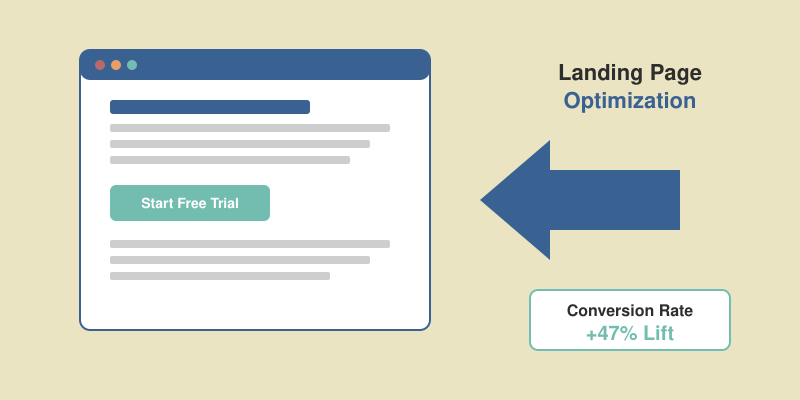
Landing Page Optimization — 12 Changes That Actually Move Conversion Rates

Most landing pages convert at around 2-3%. The top 10% of pages hit 11% or higher. That gap represents real revenue sitting on the table, and closing it rarely requires a complete redesign.

After optimizing hundreds of landing pages over the past decade, I have found that small, targeted changes consistently outperform big redesigns. The key is knowing which changes to make first and measuring everything along the way.

This guide covers 12 specific optimizations that have moved the needle in real campaigns. These are not theoretical best practices. Each one comes from actual tests with measurable results. If you are working on your broader conversion funnel optimization strategy, these landing page changes are where most teams should start.

1. Write Headlines That Match Search Intent

Your headline is the first thing visitors evaluate. If it does not match what they expected when they clicked, they leave. It is that simple.

The most common mistake I see is writing clever headlines instead of clear ones. On a B2B SaaS page I worked on, we replaced “Unleash Your Team’s Potential” with “Project Management Software for Remote Teams.” Conversions went up 34%.

Here is what works:

  • Mirror the ad copy or search query that brought visitors to the page. If your Google Ad says “Free CRM for Small Business,” your headline should say exactly that.
  • Lead with the benefit, not the feature. “Send invoices in 30 seconds” beats “Invoice automation software.”
  • Test specific numbers. Headlines with concrete numbers (“Save 12 hours per week”) outperform vague promises (“Save time”) by 15-25% in most tests I have run.

Run at least three headline variants simultaneously. Most A/B testing tools need 200-400 conversions per variant to reach statistical significance, so give each test enough traffic before calling a winner.

2. Place Your CTA Above the Fold (and Repeat It)

The debate about “above the fold” never dies, but the data is consistent: pages with a CTA visible without scrolling convert better than those that hide the action below the fold.

CTA placement comparison showing above-the-fold primary CTA with repeated CTA below fold increasing conversions by 81 percent

That said, one CTA is not enough. On longer landing pages, repeat your call to action after every major section. I tested this on a SaaS trial page: adding two additional CTAs (after the feature list and after testimonials) increased sign-ups by 27%.

CTA button copy matters as much as placement. On one SaaS landing page, changing the CTA from “Submit” to “Start Free Trial” increased conversions by 28%. The word “Submit” implies effort. “Start Free Trial” implies value.

Other CTA copy wins from my tests:

  • “Get My Free Report” beat “Download” by 22%
  • “See Pricing” beat “Learn More” by 19%
  • “Start Free — No Credit Card” beat “Sign Up Free” by 31%

3. Add Social Proof Where Decisions Happen

Social proof works, but placement determines how well it works. Testimonials buried at the bottom of the page have minimal impact. Testimonials placed next to your CTA or pricing section can lift conversions by 15-25%.

Five types of trust signals showing conversion impact from customer logos at plus 18 percent to star ratings at plus 26 percent

The most effective social proof elements I have tested, ranked by typical conversion impact:

  • Star ratings and review counts — Showing “4.8/5 from 2,340 reviews” near your CTA regularly adds 20-30%.
  • Named testimonials with photos — Anonymous quotes are almost worthless. Add a name, title, company, and photo.
  • Customer logos — Five recognizable logos above the fold consistently produce 15-20% lifts.
  • Real-time notifications — “42 people signed up today” creates urgency without feeling manipulative.

One important caveat: fake or exaggerated social proof backfires. I have seen pages where inflated numbers actually decreased conversions because visitors could tell something felt off.

4. Speed Up Your Page (Every Second Costs Conversions)

Page speed is the silent conversion killer. Most teams obsess over copy and design while ignoring the fact that their page takes five seconds to load on mobile.

Bar chart showing page speed impact on conversions from 7.2 percent at 1 second to 0.8 percent at 8 seconds load time

The data is brutal. For every additional second of load time, you lose roughly 25% of potential conversions. A page that loads in one second converts 3.5 times better than one that loads in five seconds.

Quick wins that make the biggest difference:

  • Compress images. Most landing page images are 3-5x larger than they need to be. Use WebP format and lazy loading.
  • Remove unused scripts. That analytics tag you added in 2022 and forgot about? It is costing you money.
  • Use a CDN. Serving assets from edge locations cuts 200-500ms for most visitors.
  • Defer non-critical JavaScript. Your chatbot widget does not need to load before the page content is visible.

Measure with Google PageSpeed Insights and aim for a mobile score above 80. Track your Core Web Vitals in your marketing dashboard alongside conversion data so you can correlate speed changes with conversion changes.

5. Simplify Your Forms

Every form field you add reduces completions. This is one of the most well-documented findings in conversion optimization, yet I still see landing pages with seven or eight required fields for a free trial.

Before and after form optimization showing 8 field form at 1.4 percent conversion versus 3 field form at 3.9 percent conversion

On a lead generation page I optimized last year, we cut the form from eight fields to three (name, email, company). Conversions jumped from 1.4% to 3.9% — a 179% increase. We collected the additional information through a follow-up email sequence after the initial conversion.

Rules I follow for form optimization:

  • Ask only what you need right now. If sales needs the phone number, get it on the second interaction.
  • Use smart defaults. Auto-detect country, pre-fill company from email domain, use single name field instead of first/last.
  • Add inline validation. Show errors as users type, not after they hit submit. This alone reduced form abandonment by 22% in one test.
  • Replace dropdowns with buttons when you have fewer than five options. Visual selection is faster than clicking through a menu.

6. Optimize for Mobile First

Over 60% of landing page traffic comes from mobile devices, but most pages are still designed on a desktop screen and then “made responsive” as an afterthought.

I reviewed a client’s analytics last quarter and found their mobile conversion rate was 0.8% versus 3.2% on desktop. After a mobile-first redesign focused on thumb-friendly tap targets, simplified navigation, and a sticky CTA button, mobile conversions climbed to 2.4%.

Mobile-specific optimizations that work:

  • Sticky CTA bar at the bottom of the screen — always visible, always accessible.
  • Tap targets minimum 48×48 pixels. Apple and Google both recommend this, and smaller buttons cause real frustration.
  • Collapsible sections for long content. Let users expand what interests them instead of forcing them to scroll past everything.
  • Click-to-call buttons for any page targeting high-intent visitors. If someone is on their phone looking at your pricing, make it easy to call sales.

7. Use Directional Cues to Guide Attention

People follow visual cues unconsciously. Arrows, lines, eye gaze, and whitespace all direct attention toward or away from your conversion elements.

The simplest test I recommend to every client: add an arrow or visual line pointing from your hero image toward your CTA button. This consistently produces 8-12% conversion lifts with zero copy changes.

Other directional cue tactics:

  • Human faces looking toward the CTA. Eye-tracking studies confirm that visitors follow the gaze direction of people in photos.
  • Contrasting colors for CTA buttons. Your button should be the most visually distinct element on the page.
  • Strategic whitespace. Removing visual clutter around your CTA makes it more prominent without adding anything.

8. Build Trust with Security Signals

Trust signals reduce the perceived risk of taking action. This matters most on pages where you ask for sensitive information — payment details, personal data, or business information.

The signals that produce measurable lifts:

  • SSL certificate badge near forms — adds 5-10% to form completions.
  • Money-back guarantee badge near pricing — adds 12-18% to paid conversions in most tests.
  • Privacy policy link near email fields — “We never share your email” is simple and effective.
  • Industry certifications (SOC 2, GDPR compliant, HIPAA) — particularly important for enterprise and healthcare markets.

I tested adding a “30-day money-back guarantee” badge next to the pricing CTA on a SaaS page. Paid conversions increased 16% with zero impact on refund rates. The guarantee removed hesitation without actually changing customer behavior after purchase.

9. Remove Navigation Distractions

Standard website navigation gives visitors escape routes. On a dedicated landing page, every link that leads away from your CTA is a potential leak in your funnel.

The research on this is clear: removing top navigation from landing pages increases conversions by 20-30% on average. I have seen lifts as high as 40% when removing both the header nav and footer links.

What to keep and what to remove:

  • Remove: Main navigation bar, footer links, sidebar content, blog links, social media icons.
  • Keep: Logo (linked to homepage for trust), privacy policy link, terms of service link.
  • Consider: A minimal “back to site” text link for visitors who are not ready to convert yet.

This applies specifically to campaign landing pages, not your homepage or product pages. If someone arrives from a Google Ad, they should see one focused page with one clear action.

10. Add Video to Explain Complex Offers

Video works exceptionally well when your product or offer needs explanation. For simple offers (“50% off shoes”), video adds little. For complex offers (“AI-powered project management”), a 60-90 second explainer video can lift conversions by 20-40%.

What makes landing page videos effective:

  • Keep them under 90 seconds. Engagement drops sharply after that.
  • Do not autoplay with sound. Autoplay muted is acceptable. Autoplay with sound increases bounce rate.
  • Show the product, not a talking head. Screen recordings and product demos outperform spokesperson videos in most B2B tests.
  • Include captions. 85% of social media video is watched without sound, and landing page behavior is similar.

One critical mistake: using video as a crutch for bad copy. If your written value proposition is unclear, adding a video that repeats the same unclear message will not help. Fix the copy first, then add video as reinforcement.

11. Personalize Based on Traffic Source

Visitors from different sources have different intent levels and expectations. Showing the same page to everyone leaves significant conversions on the table.

At minimum, create separate landing pages for:

  • Paid search traffic — Match the ad copy exactly. Use dynamic keyword insertion in headlines.
  • Organic search traffic — Provide more educational content. These visitors are earlier in their journey.
  • Email traffic — Reference the email they clicked from. “As we mentioned in our email…” creates continuity.
  • Social media traffic — Shorter pages, more visual content, stronger social proof (they came from a social platform, so social validation resonates).

Advanced personalization (by industry, company size, or behavior) requires more tooling but can produce 30-50% lifts. Even basic UTM-based personalization — changing the headline based on the campaign parameter — is worth implementing. It typically takes 2-3 hours to set up and produces 10-15% improvements.

12. Set Up Proper A/B Testing

Everything above is useless without proper measurement. I have watched teams make changes based on gut feeling, declare victory after a week of data, and then wonder why results did not stick.

A/B testing that actually works requires:

  • Statistical significance. You need 95% confidence before declaring a winner. Most tests need 1,000+ visitors per variant.
  • One variable at a time. If you change the headline, CTA, and layout simultaneously, you will not know which change drove the result.
  • Full business cycle testing. Run tests for at least two full weeks to account for day-of-week and time-of-day variations.
  • Tracking beyond the click. A CTA change that increases form submissions by 20% but generates lower-quality leads is not a win. Measure downstream metrics like qualified leads and revenue.

My testing framework: start with the ICE scoring model (Impact, Confidence, Ease) to prioritize which changes to test first. High-impact, high-confidence, easy-to-implement changes go first. Save the complex personalization and dynamic content tests for after you have captured the easy wins.

How to Prioritize These Changes

Twelve optimizations is a lot. Do not try to implement them all at once. Use this prioritization framework based on typical impact and implementation effort.

ICE score prioritization framework ranking 7 optimizations from headline testing at 8.7 to personalization at 5.7

Start this week (high impact, easy to implement):

  1. Test a new headline that matches search intent
  2. Optimize CTA copy and add a second CTA below the fold
  3. Remove two or more form fields you do not absolutely need

Start this month (high impact, moderate effort):

  1. Add social proof elements near your CTAs
  2. Run a page speed audit and fix the top three issues
  3. Audit mobile experience and fix tap targets

Start this quarter (high impact, significant effort):

  1. Build traffic-source-specific landing pages
  2. Implement a structured A/B testing program
  3. Add video for complex product explanations

The compounding effect matters. Each optimization builds on the others. A faster page with a clearer headline, simpler form, and strong social proof does not just add up — it multiplies. I have seen pages go from 1.5% to 6% conversion rates over three months of systematic optimization using exactly this sequence.

FAQ

What is a good landing page conversion rate?

The median conversion rate across industries is around 2.5-3%. Top-performing pages convert at 10-12% or higher. However, “good” depends entirely on your industry, traffic source, and what you are asking visitors to do. A free ebook download should convert much higher than a $10,000 enterprise demo request. Focus on improving your own baseline rather than chasing industry benchmarks.

How long should I run an A/B test on a landing page?

Run tests until you reach 95% statistical significance with at least 200-400 conversions per variant. For most pages, this means two to four weeks minimum. Never call a test early based on a few days of data — daily and weekly traffic patterns can produce misleading results that reverse over a full testing cycle.

Should I use long or short landing pages?

It depends on the offer complexity and visitor awareness. Short pages (under 500 words) work best for simple offers targeting high-intent visitors — like a free trial from a branded search ad. Long pages (1,500+ words) work better for complex or expensive offers where visitors need more information before committing. Test both formats and let the data decide rather than following a universal rule.

How many landing page variations should I test at once?

Start with two variations (A/B test) per element. Testing more than three variants simultaneously requires significantly more traffic to reach statistical significance. If your page gets fewer than 5,000 visitors per month, stick with simple A/B tests. For higher-traffic pages, you can run multivariate tests that examine how multiple elements interact with each other.

Server-Side Tracking — Why Client-Side Analytics Miss 15-30% of Visitors

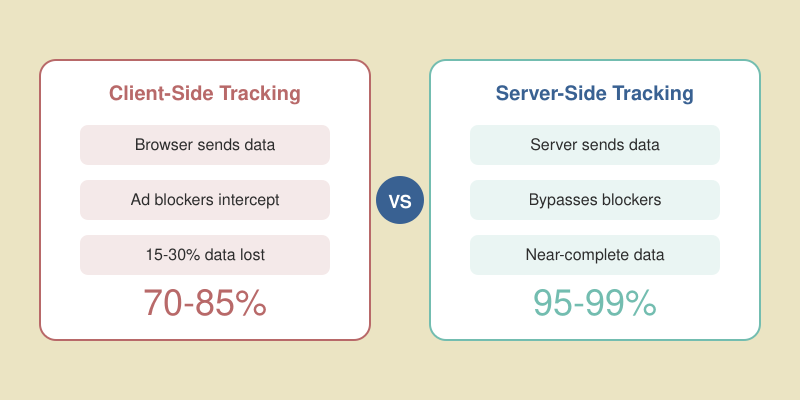
If you’ve ever looked at your analytics and felt like something was off, you’re probably right. Modern browsers, ad blockers, and privacy regulations are silently eating your tracking data — and most marketers don’t even realize it. As part of my ongoing deep dive into website traffic analysis, I want to tackle the single biggest gap in most tracking setups: the difference between client-side and server-side tracking.

When I switched a SaaS client to server-side tracking last year, we recovered 23% of lost pageview data overnight. Their conversion attribution went from “mostly guessing” to “actually useful.” That experience changed how I think about analytics infrastructure, and it’s why I’m writing this guide.

Let’s dig into what server-side tracking is, why it matters, and how to implement it without breaking the bank.

What Is Server-Side Tracking?

Server-side tracking collects visitor data on your web server instead of relying on JavaScript running in the visitor’s browser. Traditional client-side tracking loads a script (like Google Analytics or a Facebook pixel) that fires from the user’s browser. Server-side tracking moves that data collection to your server, where it cannot be blocked by browser extensions or privacy tools.

Think of it this way: client-side tracking asks the visitor’s browser to report what happened. Server-side tracking asks your server to report what happened. The server always knows about the request — it had to process it for the page to load in the first place.

This distinction matters more now than ever. In 2024, approximately 32% of global internet users ran some form of ad blocker. By 2026, that number has only grown, especially among tech-savvy audiences that many SaaS and B2B companies target.

Why Client-Side Tracking Is Losing Data

Client-side tracking has three major vulnerabilities that get worse every year:

Data gap visualization showing client-side tracking captures only 70% of visitors while server-side captures 95%

Ad blockers. Tools like uBlock Origin, Brave’s built-in blocker, and Pi-hole block tracking scripts at the network level. They target known analytics domains (google-analytics.com, facebook.com/tr) and prevent the JavaScript from loading entirely. Your analytics platform never receives the data because the request never leaves the browser.

Browser privacy features. Safari’s Intelligent Tracking Prevention (ITP) caps first-party cookies at 7 days and blocks most third-party cookies. Firefox’s Enhanced Tracking Protection blocks known trackers by default. Chrome’s Privacy Sandbox is reshaping how conversion data flows. Each update chips away at client-side tracking accuracy.

JavaScript errors and slow connections. If your analytics script fails to load (network timeout, JavaScript error, slow 3G connection), that visitor is invisible. On mobile devices in emerging markets, this can account for 5-10% of your traffic alone.

Add these together and you’re looking at 15-30% of your actual visitors being invisible to client-side analytics. For a site with 100,000 monthly visitors, that’s 15,000 to 30,000 people you’re making decisions without knowing about.

How Server-Side Tracking Works

Architecture diagram comparing client-side tracking flow blocked by ad blockers versus server-side tracking flow that bypasses them

The basic architecture is straightforward:

  1. A visitor requests a page from your web server.
  2. Your server processes the request and collects relevant data: IP address, user agent, referrer, page URL, timestamp, and any session identifiers.
  3. Your server sends that data directly to your analytics platform’s API — Google Analytics Measurement Protocol, Facebook Conversions API, or your own data warehouse.
  4. The analytics platform processes the hit exactly as if it came from a browser script.

Because the data transfer happens server-to-server, the visitor’s browser is never involved in the analytics call. Ad blockers can’t intercept it. ITP can’t restrict it. JavaScript failures don’t affect it.

That said, server-side tracking isn’t magic. You lose some browser-specific data (screen resolution, viewport size, client-side events like scroll depth) unless you implement a hybrid approach — which is what most serious implementations do.

Implementation Options: GTM Server-Side, Cloudflare Zaraz, Custom

Comparison table of three server-side tracking options: GTM Server-Side, Cloudflare Zaraz, and custom solutions with cost, difficulty, and recovery rates

There are three main paths to server-side tracking. I’ve implemented all three for different clients, and each has a clear sweet spot.

Google Tag Manager Server-Side

GTM Server-Side is Google’s official solution. You deploy a server container (typically on Google Cloud Run) that receives data from your client-side GTM container, processes it, and forwards it to analytics endpoints.

Pros: Familiar GTM interface. Works with GA4, Google Ads, Facebook CAPI, and most major platforms. Good documentation. You can map custom UTM parameters and enrich data before sending it downstream.

Cons: Requires a cloud server ($50-150/month depending on traffic). Still partially relies on client-side GTM to collect initial data. Setup takes 4-8 hours for someone experienced.

Best for: Teams already using GTM who need to recover data for Google Ads and GA4 specifically. Mid-size companies with $50K+ annual ad spend where the recovered conversion data pays for itself.

Cloudflare Zaraz

If you’re already using Cloudflare (and roughly 20% of all websites do), Zaraz is the easiest path to server-side tracking. It runs third-party scripts at Cloudflare’s edge instead of in the browser, giving you most server-side benefits without managing your own server.

Pros: Free tier available. Setup takes under an hour. No server management. Reduces page load time because scripts run at the edge.

Cons: Limited to Cloudflare users. Fewer integrations than GTM. Less flexibility for custom data transformation. The free tier has usage limits.

Best for: Small to mid-size sites already on Cloudflare who want quick wins without infrastructure complexity.

Custom Server-Side Implementation

Building your own tracking pipeline — typically with a lightweight endpoint on your existing server that collects events and forwards them via API.

Pros: Full control over data. No vendor lock-in. Can achieve 95-99% data recovery. Works with any analytics platform. You own the entire pipeline.

Cons: Requires development resources. You’re responsible for maintenance, scaling, and compliance. Can take 40-80 hours to build properly.

Best for: Companies with development teams who want maximum data accuracy and already use privacy-first analytics tools like Plausible, Fathom, or self-hosted Matomo.

Server-Side Tracking Best Practices

After implementing server-side tracking for over a dozen clients, here are the practices that separate clean implementations from messy ones:

Use a hybrid approach. Don’t abandon client-side tracking entirely. Run both in parallel. Client-side gives you rich browser data (events, scroll depth, element visibility). Server-side fills in the gaps from blocked users. Deduplicate by matching on session ID or client ID.

Set up a first-party subdomain. Route your tracking through a subdomain like t.yourdomain.com instead of sending data to google-analytics.com. This bypasses most ad blocker lists and keeps data flowing even when the main analytics domain is blocked.

Implement proper consent management. Server-side tracking doesn’t mean you can ignore consent. You still need to respect user opt-outs. Build consent checks into your server logic, not just your client-side scripts.

Log and monitor data quality. Compare client-side vs. server-side numbers weekly. The delta tells you your “tracking gap.” If it suddenly changes, something broke. I set up a simple dashboard that shows both data sources side by side — it’s caught issues within hours instead of weeks.

Start with conversions, not pageviews. If budget is tight, focus server-side tracking on high-value events: purchases, sign-ups, demo requests. Recovering 25% of lost conversion data has a much higher ROI than recovering 25% of lost pageview data.

Cost Analysis: Is It Worth the Investment?

Cost analysis comparing annual server-side tracking costs of $3,800-10,400 against value recovered showing 3-10x ROI

Let’s talk real numbers. Here’s what I’ve seen across implementations:

Small site (under 50K monthly visitors): Cloudflare Zaraz’s free tier or a $50/month GTM Server-Side container on Cloud Run. Total annual cost: $0-600. At this scale, the primary benefit is data accuracy rather than direct revenue recovery.

Mid-size site (50K-500K monthly visitors): GTM Server-Side on a dedicated Cloud Run instance: $100-150/month. One-time setup cost: $2,000-5,000 (agency or consultant). Annual running cost: $1,200-1,800. If you’re spending $50K+ on paid ads, recovering 15-25% of lost conversion data typically pays for the implementation within 2-3 months.

Enterprise (500K+ monthly visitors): Custom implementation or GTM Server-Side with dedicated infrastructure: $200-500/month hosting. Significant one-time build cost: $10,000-30,000. But at this scale, the recovered data often represents six or seven figures in better-attributed revenue.

The honest truth: if you’re a small blog or content site with no ad spend, server-side tracking is probably overkill. But if you’re running paid campaigns and making decisions based on conversion data, the ROI is almost always positive within the first year.

Privacy Implications and Compliance

Server-side tracking creates a tension that’s worth being honest about. On one hand, it can bypass tools that users install specifically to avoid tracking. On the other hand, it provides more accurate data for legitimate business analytics.

Here’s how I navigate this:

GDPR and CCPA still apply. Server-side tracking doesn’t exempt you from privacy regulations. If a user hasn’t consented to tracking under GDPR, you can’t track them server-side either. Your consent management platform needs to gate server-side events just like client-side ones.

First-party data is safer. Server-side tracking naturally encourages a first-party data approach. You’re collecting data on your own server through your own domain. This aligns better with the direction privacy regulations are heading than relying on third-party cookies.

Be transparent. Update your privacy policy to mention server-side data collection. Users deserve to know how their data is processed, even if the mechanism has changed from client to server.

IP anonymization matters. When forwarding data to analytics platforms, truncate IP addresses. Google’s Measurement Protocol supports this. Most custom implementations can add IP anonymization with a few lines of code.

My personal rule: use server-side tracking to get accurate counts and attribution for users who haven’t opted out. Never use it to circumvent explicit opt-out choices. The line between “recovering lost data” and “bypassing user preferences” is real, and staying on the right side of it is both ethically correct and legally necessary.

Common Challenges and Solutions

Every server-side tracking implementation I’ve done has hit at least one of these issues:

Challenge: Duplicate events. Running client-side and server-side tracking in parallel means some events fire twice. Solution: Use a shared event ID. Before sending a server-side event, check if the client already sent it. Most platforms (GA4, Facebook) support deduplication via event IDs.

Challenge: Missing client-side context. Server-side requests don’t carry browser data like screen resolution or timezone. Solution: Capture essential browser data in a lightweight first-party cookie on the first page load, then read that cookie server-side on subsequent requests.

Challenge: Consent synchronization. A user opts out on the client, but the server doesn’t know yet. Solution: Store consent status in a first-party cookie. Check it server-side before firing any tracking events. Update it in real-time when consent changes.

Challenge: Debugging is harder. You can’t just open browser dev tools to see server-side requests. Solution: Build a logging endpoint. I create a simple /tracking/debug page that shows the last 100 events processed server-side. Invaluable during setup and troubleshooting.

Challenge: Session stitching. Connecting server-side pageviews to client-side events for the same user. Solution: Generate a session ID on first page load (client-side), store it in a first-party cookie, and include it in both client and server events. This gives you a unified session across both data sources.

FAQ

Does server-side tracking completely replace client-side tracking?

No. The best approach is hybrid — client-side for rich browser events (scroll depth, element clicks, viewport data) and server-side for pageviews, conversions, and data recovery. Running both with deduplication gives you the most complete picture.

Is server-side tracking legal under GDPR?

Server-side tracking is legal as long as you comply with the same consent requirements as client-side tracking. You still need valid consent before processing personal data. The collection mechanism (client vs. server) doesn’t change your legal obligations under GDPR, CCPA, or other privacy laws.

How much does server-side tracking cost for a small business?

For small businesses, Cloudflare Zaraz offers a free tier that covers basic server-side tracking. GTM Server-Side starts at roughly $50/month for a Cloud Run container. Custom solutions can run on existing server infrastructure for near-zero marginal cost. Most small businesses can start for under $100/month.

Can ad blockers detect and block server-side tracking?

Standard ad blockers cannot block server-side tracking because the data transfer happens between your server and the analytics platform — the browser is never involved. However, some advanced privacy tools can block first-party cookies needed for session tracking. Using a first-party subdomain and first-party cookies makes detection extremely difficult.

Technical SEO Audit Checklist — A Hands-On Guide for 2026

When was the last time you actually crawled your own site and looked at what Google sees? If you’re like most site owners I’ve worked with, the answer is either “never” or “too long ago.” I’ve run technical SEO audits on over 50 sites in the past five years, and the pattern is always the same: small technical issues quietly stack up until rankings start slipping.

A technical SEO audit isn’t glamorous. There’s no viral hack or secret trick. It’s methodical work that makes sure search engines can find, crawl, index, and rank your pages properly. Think of it as the foundation inspection before you decorate the house.

This guide walks you through every step of a technical SEO audit in 2026. I’ve organized it as a checklist you can follow from top to bottom, whether you’re auditing a 50-page blog or a 50,000-page e-commerce site.

What You Need for a Technical SEO Audit

Before you start digging into issues, gather your tools. You don’t need expensive enterprise software for a solid audit. Here’s my standard toolkit:

  • Google Search Console — Your single most important free tool. It shows exactly what Google sees, including crawl errors, index coverage, and Core Web Vitals data.
  • Screaming Frog SEO Spider — The free version crawls up to 500 URLs. For most small-to-medium sites, that’s enough. The paid version ($259/year) handles unlimited URLs.
  • PageSpeed Insights — Google’s own speed testing tool, powered by Lighthouse. Tests both mobile and desktop performance.
  • Chrome DevTools — Built into every Chrome browser. The Network and Performance tabs are essential for debugging speed issues.
  • Ahrefs Webmaster Tools or Semrush — Either works for checking backlink health and finding technical issues at scale.

Set aside 2-4 hours for a thorough audit of a site with fewer than 1,000 pages. Larger sites may take a full day. I recommend scheduling audits quarterly — monthly if you publish frequently or make regular site changes.

Crawlability and Indexing

Diagram showing the crawlability and indexing flow from Googlebot through robots.txt, XML sitemap, to indexed pages with status checks

If search engines can’t crawl your pages, nothing else matters. This is always my first stop in any audit.

Check Your robots.txt

Visit yoursite.com/robots.txt and look for anything suspicious. I once found a client’s staging Disallow: / directive that accidentally stayed after a migration. Their organic traffic dropped 73% before anyone noticed. The fix took 30 seconds; the recovery took three months.

Make sure you’re not accidentally blocking important directories, CSS files, or JavaScript that Googlebot needs to render your pages. Use Google’s robots.txt tester in Search Console to validate.

Review Your XML Sitemap

Your sitemap should include every page you want indexed and exclude everything you don’t. Check for these common issues:

  • Pages returning 404 or 301 status codes listed in the sitemap
  • Non-canonical URLs included
  • Sitemap not submitted in Google Search Console
  • Sitemap file exceeding the 50,000 URL or 50MB limit

For a deeper dive into sitemap best practices, I wrote a comprehensive guide on XML sitemaps for large websites that covers everything from sitemap indexes to dynamic generation.

Check Index Coverage

In Google Search Console, go to Pages (formerly Index Coverage). Look for pages marked as “Discovered – currently not indexed” or “Crawled – currently not indexed.” These are pages Google found but chose not to index — often a sign of thin content, duplicate issues, or crawl budget problems.

Run a site:yoursite.com search in Google to get a rough count of indexed pages. Compare that to your total page count. If there’s a big gap, you’ve got indexing issues to investigate.

Site Speed and Core Web Vitals

Core Web Vitals targets showing LCP under 2.5 seconds, INP under 200 milliseconds, and CLS under 0.1 with optimization tips

Google has confirmed that Core Web Vitals are a ranking factor. In 2026, the three metrics that matter are:

Largest Contentful Paint (LCP) measures how quickly the main content loads. Target: under 2.5 seconds. The biggest culprits for poor LCP are unoptimized images, slow server response times, and render-blocking CSS or JavaScript. On one audit, I found a client loading a 4.2MB hero image. Compressing it to 180KB dropped their LCP from 6.1s to 1.8s.

Interaction to Next Paint (INP) replaced First Input Delay in 2024. It measures responsiveness across all interactions, not just the first one. Target: under 200ms. Heavy JavaScript frameworks are the usual culprit. Break long tasks into smaller chunks and defer non-critical scripts.

Cumulative Layout Shift (CLS) measures visual stability. Target: under 0.1. Always set explicit width and height attributes on images and video elements. Reserve space for ad slots and dynamically loaded content. I’ve seen CLS scores drop from 0.35 to 0.02 just by adding image dimensions.

Quick Speed Wins

These fixes consistently deliver the biggest improvements in my audits:

  1. Enable compression — Gzip or Brotli compression typically reduces file sizes by 70-80%.
  2. Implement browser caching — Set cache headers for static assets (images, CSS, JS) with expiry times of at least one year.
  3. Optimize images — Use WebP or AVIF format, lazy load below-the-fold images, and serve responsive sizes.
  4. Minimize render-blocking resources — Inline critical CSS, defer non-essential JavaScript, and use font-display: swap for web fonts.
  5. Use a CDN — Content delivery networks reduce latency by serving assets from geographically closer servers.

Mobile-Friendliness and Responsive Design

Google uses mobile-first indexing, meaning it primarily uses the mobile version of your content for indexing and ranking. If your site doesn’t work well on mobile, you’re invisible to a huge portion of search traffic.

Here’s what to check:

  • Viewport meta tag — Make sure <meta name="viewport" content="width=device-width, initial-scale=1"> is present on every page.
  • Tap targets — Buttons and links should be at least 48×48 pixels with adequate spacing. Google flags small tap targets as mobile usability issues.
  • Text readability — Font size should be at least 16px for body text without requiring pinch-to-zoom.
  • No horizontal scrolling — Content should fit within the viewport width. Test on actual devices, not just Chrome DevTools.
  • Content parity — Your mobile and desktop versions should have the same content. Hidden content on mobile may not get indexed.

I audit mobile usability by actually using the site on my phone for 10 minutes. Automated tools catch many issues, but nothing beats the frustration of trying to tap a tiny link with your thumb to motivate fixing it.

HTTPS and Security

HTTPS and security checklist showing a shield icon with SSL security checks including certificate validation, redirects, and security headers

HTTPS has been a ranking signal since 2014, and in 2026 it’s essentially mandatory. Browsers actively warn users about non-secure sites, which kills trust and increases bounce rates.

SSL Certificate Checks

Verify your SSL certificate is valid and not expiring soon. I schedule quarterly certificate checks because an expired cert can take your entire site offline. Most hosting providers now include free SSL through Let’s Encrypt, so there’s no excuse for running HTTP in 2026.

Mixed Content Issues

Mixed content happens when your HTTPS pages load resources (images, scripts, stylesheets) over HTTP. This triggers browser warnings and can break page functionality. Use Chrome DevTools Console to identify mixed content warnings, then update the URLs to HTTPS.

Security Headers

While not direct ranking factors, security headers signal a well-maintained site:

  • HSTS (Strict-Transport-Security) — Forces HTTPS connections
  • X-Content-Type-Options: nosniff — Prevents MIME type sniffing
  • X-Frame-Options — Protects against clickjacking
  • Content-Security-Policy — Controls which resources can load

Check your headers at securityheaders.com — an A+ grade takes 15 minutes to configure and gives you peace of mind.

Structured Data and Schema Markup

Structured data helps search engines understand your content and can earn rich results (star ratings, FAQ dropdowns, how-to steps) in search results. These rich results consistently improve click-through rates by 20-30% in my experience.

Common Schema Types to Audit

  • Article/BlogPosting — For blog posts and news articles
  • Organization — Your brand information, logo, social profiles
  • FAQ — Frequently asked questions that can appear directly in search results
  • BreadcrumbList — Navigation breadcrumbs that show site hierarchy in SERPs
  • Product — For e-commerce pages with price, availability, and reviews
  • HowTo — Step-by-step instructions with optional images

Use Google’s Rich Results Test to validate your structured data. Look for errors and warnings — even valid schema can have issues that prevent rich results from showing. For a complete implementation guide, check out my article on schema markup for SEO.

JSON-LD Best Practices

Always use JSON-LD format (recommended by Google) rather than Microdata or RDFa. Place it in the <head> section. Make sure the structured data accurately represents the page content — Google penalizes misleading markup. One site I audited had Product schema on their blog posts, which resulted in a manual action that took weeks to resolve.

Internal Linking and Site Architecture

Internal linking structure diagram showing homepage connected to categories and posts with parent links and cross-links

Internal links distribute authority across your site and help search engines understand your content hierarchy. Poor internal linking is the most underrated technical SEO issue I encounter.

The Three-Click Rule

Every important page should be reachable within three clicks from the homepage. Use Screaming Frog’s crawl depth report to identify pages buried too deep. Pages at crawl depth 4+ often struggle to rank because they receive less internal link equity.

Orphan Pages

Orphan pages have no internal links pointing to them. They’re essentially invisible to search engine crawlers that follow links. I find orphan pages on nearly every audit — usually old landing pages or product pages that were removed from navigation but never redirected or deleted.

Anchor Text Distribution

Review your internal link anchor text. It should be descriptive and varied, naturally incorporating relevant keywords. Avoid generic text like “click here” or “read more.” Descriptive anchors help both users and search engines understand what they’ll find on the linked page.

Broken Internal Links

Run a full crawl and export all links returning 404 status codes. Every broken link is a dead end for both users and crawlers. Fix them by updating the URL, setting up a 301 redirect, or removing the link entirely. On a recent audit, I found 127 broken internal links on a 400-page site — all caused by a URL restructuring that nobody updated the old links for.

Canonical Tags and Duplicate Content

Duplicate content confuses search engines because they don’t know which version to rank. Canonical tags tell Google which URL is the “official” version of a page.

Common Duplicate Content Issues

  • WWW vs non-WWW — Pick one and redirect the other with a 301.
  • Trailing slashes/page/ and /page are technically different URLs. Be consistent.
  • HTTP vs HTTPS — All HTTP URLs should redirect to HTTPS.
  • URL parameters — Sorting, filtering, and tracking parameters create duplicate URLs. Use canonical tags or parameter handling in Search Console.
  • Pagination — Category and archive pages with pagination need proper canonical treatment.

Auditing Canonical Tags

Crawl your site and check that every page has a self-referencing canonical tag, every canonical URL returns a 200 status code, no page canonicalizes to a redirected or 404 URL, and canonical tags match between mobile and desktop versions.

I once found a site where a plugin was setting canonical tags to a staging domain. Every page was telling Google that the “real” version lived at staging.example.com. Traffic dropped 60% before the team noticed. Always verify your canonicals point to production URLs.

Hreflang for International Sites

If you serve content in multiple languages or target different regions, implement hreflang tags. Each language version should reference all other versions, including itself. Errors here are extremely common — Google’s John Mueller has called hreflang “one of the most complex aspects of SEO.” Validate your implementation with hreflang-checker tools before assuming everything works.

The Complete Checklist

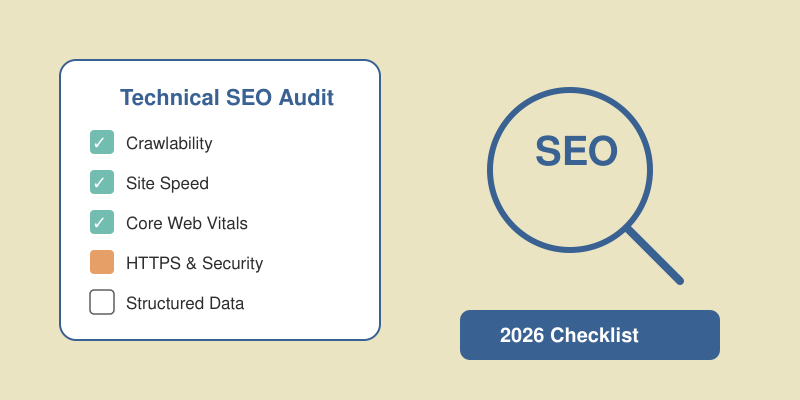
Complete technical SEO audit summary with foundation checks and performance checks organized in two columns

Here’s every check from this guide in one place. I print this out and work through it section by section during audits:

Crawlability & Indexing

  • robots.txt allows important pages and resources
  • XML sitemap is valid and submitted to Search Console
  • No critical pages blocked by noindex tags
  • Index coverage report shows no unexpected exclusions
  • Site:search count roughly matches expected page count

Site Speed & Core Web Vitals

  • LCP under 2.5 seconds on mobile and desktop
  • INP under 200ms
  • CLS under 0.1
  • Images compressed and served in modern formats
  • Browser caching and compression enabled

Mobile & Responsiveness

  • Viewport meta tag present on all pages
  • Tap targets at least 48x48px
  • No horizontal scrolling on mobile
  • Content parity between mobile and desktop

HTTPS & Security

  • Valid SSL certificate with adequate expiry date
  • HTTP to HTTPS redirects working
  • No mixed content warnings
  • Security headers configured

Structured Data

  • Schema markup valid in Rich Results Test
  • JSON-LD format used (not Microdata)
  • Markup accurately reflects page content
  • No manual actions for structured data in Search Console

Internal Linking

  • All important pages within 3 clicks of homepage
  • No orphan pages
  • No broken internal links (404s)
  • Descriptive anchor text used

Canonicals & Duplicates

  • Self-referencing canonical on every page
  • WWW/non-WWW redirect in place
  • URL parameters handled properly
  • Hreflang tags correct (if applicable)

FAQ

How often should I run a technical SEO audit?

I recommend a full technical audit every quarter, with monthly spot checks on critical metrics like Core Web Vitals and crawl errors. If you’re making frequent site changes — redesigns, migrations, new features — increase the frequency to monthly. Automated monitoring tools can alert you to issues between scheduled audits.

Can I do a technical SEO audit without paid tools?

Absolutely. Google Search Console, PageSpeed Insights, Chrome DevTools, and the free version of Screaming Frog cover about 80% of what you need. Paid tools like Ahrefs or Semrush add convenience with scheduled crawls and historical data, but they’re not required for an effective audit. I did my first two years of professional audits with only free tools.

What’s the most common technical SEO issue you find?

Broken internal links and missing or incorrect canonical tags, by far. On average, I find 15-20 broken internal links per 100 pages audited. These accumulate over time as content gets updated, moved, or deleted without proper redirects. The fix is straightforward but tedious — which is why automated crawling tools are so valuable.

How long does it take to see results from fixing technical SEO issues?

It depends on the severity. Critical issues like a robots.txt blocking your entire site can show improvement within days of fixing. Core Web Vitals improvements typically reflect in rankings within 2-4 weeks. Broader changes like fixing internal linking structure or resolving duplicate content usually take 4-8 weeks as Google recrawls and re-evaluates your pages.

How to Set Up GA4 Funnel Explorations — Complete Walkthrough

If you have ever wondered where users drop off before converting, GA4 funnel explorations are the answer. This feature inside Google Analytics 4 lets you build custom, multi-step funnels that show exactly how visitors move through your site — and where they leave.

I set up funnel explorations for over 30 client accounts during my time consulting for SaaS and e-commerce brands. The pattern is almost always the same: teams track pageviews and conversions, but they have no idea what happens between those two points. Funnel explorations fill that gap.

This walkthrough covers everything from creating your first funnel to advanced techniques like trended analysis and segment comparisons. If you are working on conversion funnel optimization, this is the hands-on companion guide you need.

What You Need Before Starting

Before you open the Explorations tab, make sure a few things are in place. Skipping these basics is the number one reason funnels show confusing data.

GA4 property with data. You need at least 7 days of collected events. Funnel explorations pull from processed data, so freshly created properties will show blank reports. I recommend waiting for at least 2 weeks of data before drawing any conclusions.

Key events configured. GA4 automatically collects events like session_start, page_view, and first_visit. But for meaningful funnels, you need custom events too. Think sign_up, add_to_cart, begin_checkout, or purchase. Set these up through Google Tag Manager or the GA4 admin panel.

Editor or Analyst access. Explorations require at least Editor-level permissions on the GA4 property. Viewer-level accounts can see shared explorations but cannot create new ones.

If you are tracking a SaaS product, make sure your activation events are firing correctly. I covered which events matter most in my guide on metrics every SaaS startup should track.

Step 1 — Create a New Funnel Exploration

Open your GA4 property and click Explore in the left sidebar. You will see a template gallery. Click Funnel exploration to start with the pre-built template, or click Blank and add the funnel visualization technique manually.

I prefer starting from the funnel exploration template because it pre-loads the technique and saves a few clicks. Once you select it, GA4 creates a new exploration with a default funnel that usually includes first_visit, session_start, and purchase.

Name your exploration something descriptive. Instead of “Funnel exploration 1,” try “Checkout Funnel — Q1 2026” or “SaaS Trial to Paid Flow.” You will thank yourself later when you have 15 explorations stacked up in the list.

The exploration workspace has two panels. The left panel (Variables) holds your date range, segments, dimensions, and metrics. The right panel (Tab Settings) is where you configure the funnel steps, visualization type, and breakdowns. Most of the action happens in Tab Settings.

Step 2 — Define Your Funnel Steps

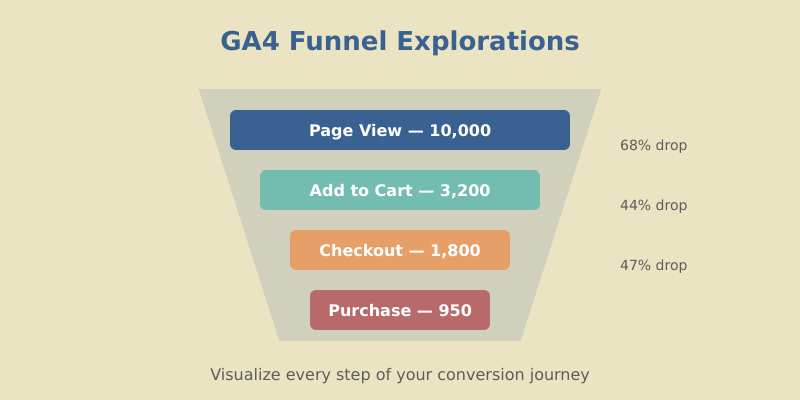
Funnel steps diagram showing four sequential events with completion rates between each step

This is the most important part. Click Steps in the Tab Settings panel, then click the pencil icon to edit. Each step represents an action you expect users to take on their journey toward conversion.

Step 1: Entry event. Choose where the funnel starts. For an e-commerce site, this might be page_view with a parameter filter for your product pages. For a SaaS app, it could be session_start or a custom view_pricing event.

Step 2: Engagement event. What should users do next? Common choices include add_to_cart, sign_up, or view_item. Pick the action that signals real interest.

Step 3: Commitment event. This is where users start committing. Think begin_checkout, start_trial, or submit_form.

Step 4: Conversion event. Your final goal — purchase, subscribe, or whatever counts as a win.

You can add up to 10 steps per funnel. In practice, 4 to 6 steps work best. I once built a 9-step funnel for a client and it was so granular that every step showed a tiny drop. It looked alarming but was actually normal behavior. Keep your funnels focused on the decisions that matter.

Pro tip: Use the “Add parameter” option within each step to narrow it down. For example, instead of all page_view events, filter for page_location containing “/pricing” to capture only pricing page views.

Step 3 — Configure Funnel Settings (Open vs Closed)

Comparison of open funnel allowing entry at any step versus closed funnel requiring sequential completion

Right below the steps editor, you will find a toggle called Make open funnel. This single setting changes how GA4 counts users, and it is misunderstood more often than any other funnel feature.

Closed funnel (default). Users must enter at Step 1. If someone skips straight to Step 3 without doing Steps 1 and 2, they are not counted. This is strict and sequential. Use closed funnels for processes where the order matters — like a checkout flow where users cannot purchase without adding to cart first.

Open funnel. Users can enter at any step. If someone lands directly on your checkout page (maybe they bookmarked it), they get counted at that step. Use open funnels when you want to see the total volume at each stage, regardless of path.

Here is when to use each:

  • Closed funnel: Checkout flows, multi-step forms, SaaS onboarding sequences, any process with a fixed order
  • Open funnel: General site behavior, content consumption paths, lead generation funnels where users might enter at different points

I ran both versions for a SaaS client last year. The closed funnel showed a 4.2% completion rate. The open funnel showed 11.8%. The difference was that many users were entering at Step 2 (pricing page) directly from Google ads, bypassing the homepage entirely. The open funnel revealed this alternate path that we had been ignoring.

You can also toggle Elapsed time to see how long users take between steps. This is useful for identifying steps where users hesitate. If the average time between “view pricing” and “start trial” is 6 days, you might need better mid-funnel content or a follow-up email sequence.

Step 4 — Add Segments and Breakdowns

Three funnel segments compared side by side showing mobile desktop and organic traffic conversion rates

A funnel without segments is like a report card without the subject names. You see the grade, but you do not know what is driving it.

Adding segments. In the Variables panel on the left, click the + next to Segments. GA4 offers three segment types:

  • User segments: Filter by user properties like country, age group, or lifetime value
  • Session segments: Filter by session-level attributes like traffic source, campaign, or device category
  • Event segments: Filter by specific event conditions like users who triggered a particular action

Create your segments, then drag them into the Segment comparisons area in Tab Settings. You can compare up to 4 segments side by side.

The most revealing comparison I use regularly is mobile vs. desktop. In one project, desktop users converted at 15.1% through the funnel while mobile users converted at only 5.6%. The drop-off was concentrated at the form step — the mobile form had tiny input fields and no auto-fill support. Fixing that one issue lifted mobile conversions by 40%.

Adding breakdowns. Breakdowns split your funnel data by a dimension without creating separate funnels. Drag a dimension like Device category, Country, or First user source into the Breakdown area. This adds columns to your funnel table showing how each dimension value performs at every step.

Useful breakdown dimensions:

  • Device category: Mobile vs. desktop vs. tablet behavior
  • First user source / medium: How acquisition channels perform through the funnel
  • Country: Regional differences in conversion behavior
  • Operating system: Catch platform-specific bugs killing conversions

Step 5 — Read and Interpret Your Funnel Data

Once your funnel is configured, GA4 displays a bar chart visualization with a data table below. Here is how to read it effectively.

Completion rate. This is the percentage of users who made it from one step to the next. A healthy e-commerce funnel typically shows 30-60% completion between product view and add-to-cart, then 40-70% from cart to checkout, and 60-80% from checkout to purchase.

Abandonment rate. The flip side of completion. If 68% of users drop off between Steps 1 and 2, that is your biggest leak. Focus optimization efforts on the step with the highest absolute drop-off (not just the highest percentage).

Abandonment bar. Click on the abandonment section of any step to see where those users went instead. GA4 shows the next events they triggered after leaving the funnel. This is gold for understanding why users leave.

I always look at three things in this order:

  1. The biggest absolute drop. Which step loses the most users? That is your priority.
  2. The segment differences. Is the drop consistent across all segments, or is one group struggling more? If mobile users drop 3x more than desktop at the same step, you have a UX problem, not a funnel problem.
  3. The time between steps. Long gaps suggest friction or decision fatigue. Short gaps mean the flow is smooth but users are just deciding against continuing.

Advanced Techniques: Trended Funnels and Elapsed Time

Line chart showing funnel step completion rates trending upward over four weeks

Once you have a baseline funnel working, there are two advanced features that unlock deeper insights.

Trended funnel. In Tab Settings, change the visualization from Standard funnel to Trended funnel. Instead of a bar chart, you get a line chart showing completion rates over time. This is incredibly useful for measuring the impact of changes.

For example, if you redesigned your checkout page on March 1, switch to a trended funnel and compare the two weeks before and after. You will see whether the checkout-to-purchase completion rate actually improved. I used this for a client who was convinced their new checkout was better — the trended funnel showed completion rate actually dropped from 72% to 61% after the redesign. They rolled it back within a week.

Elapsed time analysis. Toggle “Show elapsed time” in your funnel settings. GA4 adds a row showing the average and median time between steps. Use this to identify bottlenecks that are not visible from completion rates alone.

A SaaS client found that 78% of users who signed up for a trial completed onboarding within 24 hours. But users who took longer than 3 days had only a 12% completion rate. This insight drove them to build an automated email sequence that triggered on day 2, and trial-to-paid conversion jumped by 23%.

Next action after abandonment. Click the abandonment bar for any step to see what events users triggered after leaving your funnel. Common findings include users visiting help pages (confusion signal), returning to a previous step (comparison shopping), or leaving the site entirely (price shock or trust issue).

Common Mistakes to Avoid

After building hundreds of funnels across different accounts, I keep seeing the same mistakes.

Too many steps. Funnels with 8 or more steps almost always show small drop-offs at every stage. This makes it hard to identify the real problem. Stick to 4-6 steps that represent meaningful decisions.

Using closed funnels for non-linear journeys. If users regularly enter your flow at different points — common with content sites and organic traffic — a closed funnel will undercount your total engagement. Start with an open funnel to see the full picture, then use closed funnels for strictly sequential processes.

Ignoring the date range. The default date range in Explorations is often the last 28 days. If you recently changed something on your site, that date range blends old and new behavior. Always set a specific date range that matches what you are trying to measure.

Not using parameter filters. A step set to “page_view” captures every page on your site. That is too broad. Add parameter filters to narrow steps to specific pages or page groups. For example, filter page_location to match your product category pages only.

Comparing unequal segments. If your mobile segment has 500 users and your desktop segment has 10,000, percentage comparisons can be misleading. Always check the absolute numbers alongside the rates.

Forgetting sampling. GA4 explorations may sample data when your date range or user count is large. Look for the shield icon at the top of your exploration — if it shows a percentage less than 100%, your data is sampled. Narrow your date range or segments to reduce sampling.

FAQ

How many steps can I add to a GA4 funnel exploration?

GA4 allows up to 10 steps per funnel exploration. However, 4 to 6 steps is the sweet spot for most analyses. Too many steps create noise and make it harder to identify which drop-off actually matters. Each step should represent a meaningful user decision, not just a micro-interaction.

What is the difference between a standard funnel and a trended funnel in GA4?

A standard funnel shows a snapshot of completion and abandonment rates for a given date range as a bar chart. A trended funnel shows how those same completion rates change over time as a line chart. Use standard funnels for diagnosing current problems and trended funnels for measuring whether your optimizations are actually working.

Can I share funnel explorations with my team?

Yes. Click the share icon in the top-right corner of your exploration. This makes it visible to anyone with access to the GA4 property. Note that shared explorations are read-only for other users — they can view and interact with them but cannot edit your configuration. If a teammate needs to modify the funnel, they should duplicate it first.

Why does my GA4 funnel show different numbers than my reports?

Explorations and standard reports can show different numbers because they use different processing methods. Explorations may apply data sampling when dealing with large datasets, and they use session-based or user-based scoping depending on your segment type. Standard reports use pre-aggregated, unsampled data. If you see significant discrepancies, check for sampling (shield icon), verify your date range matches, and confirm your segment type aligns with the report scope.

GA4 vs Matomo vs Plausible — Privacy-First Analytics Compared

Privacy regulations keep getting stricter, and the analytics tools you relied on a few years ago may no longer cut it. If you run a website in 2026, choosing a privacy-first analytics platform is not just about compliance — it is about building trust with your audience and getting accurate data without cookie consent banners scaring visitors away.

I have spent over a decade helping businesses set up measurement stacks, and the question I hear most often right now is: “Should I stick with GA4, switch to Matomo, or go with Plausible?” The answer depends on your priorities, budget, and technical comfort level.

This comparison breaks down all three tools across privacy, accuracy, pricing, and features so you can make a confident choice. If you are new to traffic measurement, start with our website traffic analysis playbook for the full picture.

Quick Comparison Table

Before we dive deep, here is a bird’s-eye view of how GA4, Matomo, and Plausible stack up on the factors that matter most.

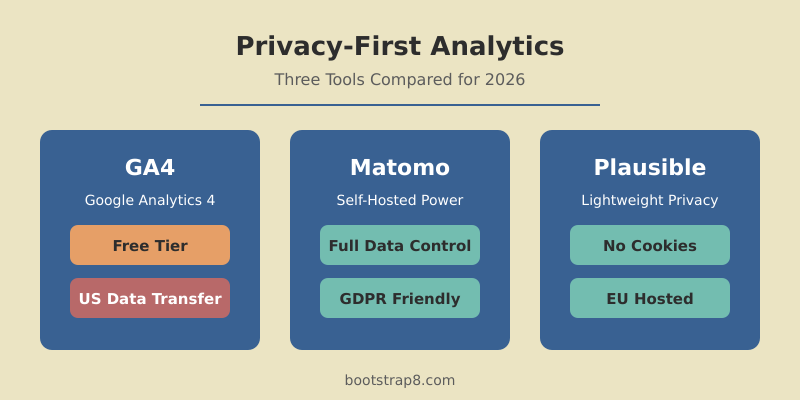
Feature comparison matrix showing GA4, Matomo, and Plausible across six key categories including cookie-free tracking, self-hosting, and GDPR compliance
Feature GA4 Matomo Plausible
Price (100K views) Free Free (self) / $35/mo (cloud) $19/mo (cloud) / Free (self)
Cookie-free mode No Optional Yes (default)
Self-hosting No Yes Yes
GDPR without consent No If self-hosted Yes
Ecommerce tracking Advanced Advanced Revenue goals only
Learning curve Steep Moderate Easy
Script size ~45 KB ~22 KB <1 KB
Real-time dashboard Yes Yes Yes

Google Analytics 4 — The Industry Default

GA4 replaced Universal Analytics in 2023, and it remains the most widely used analytics platform in the world. Its biggest selling point is obvious: it is free for most websites, deeply integrated with Google Ads, and backed by machine learning models that can surface insights automatically.

The event-based data model is genuinely powerful once you learn it. You can track custom events, build audiences for remarketing, and export raw data to BigQuery for advanced analysis. For marketing teams running paid campaigns, the integration with Google Ads attribution is hard to beat.

However, GA4 has real privacy problems. It sets cookies, transfers data to US servers, and requires a consent banner under GDPR. In my experience working with EU-based clients, consent rates typically hover around 40 to 60 percent — meaning you lose nearly half your traffic data before you even start analyzing.

GA4 Pros

  • Free for up to 10 million events per month
  • Deep Google Ads and Search Console integration
  • Machine learning insights and predictive audiences
  • BigQuery export for raw data analysis
  • Massive community, tutorials, and agency support

GA4 Cons

  • Requires cookie consent banners (GDPR, ePrivacy)
  • Data sampled at higher traffic volumes in free tier
  • Steep learning curve — the UI frustrates even experienced analysts
  • Data stored on Google servers (US jurisdiction)
  • No self-hosting option

Matomo — The Self-Hosted Powerhouse

Matomo (formerly Piwik) is the open-source analytics platform that has been around since 2007. It is the most feature-rich GA4 alternative and the only one on this list that genuinely matches Google’s analytics depth.

When I migrated a client from GA4 to Matomo last year, the biggest win was data ownership. Every pageview, event, and conversion lived on their own server. No third-party data sharing, no ambiguity about where visitor information ends up. For a healthcare SaaS company dealing with sensitive user data, that was a dealbreaker in Matomo’s favor.

The self-hosted version is completely free. You install it on your server, point a subdomain at it, and you are up and running. The cloud-hosted version starts at $23 per month for 50,000 pageviews and scales from there.

Matomo Pros

  • 100% data ownership when self-hosted
  • Feature parity with GA4 (funnels, ecommerce, heatmaps, session recordings)
  • GDPR-compliant without consent when self-hosted and configured correctly
  • Import historical data from GA4
  • Tag manager included

Matomo Cons

  • Self-hosting requires server maintenance and MySQL knowledge
  • Cloud pricing gets expensive at high traffic (500K views = $109/mo)
  • UI feels dated compared to modern tools
  • Performance can degrade on shared hosting at scale
  • Some premium features (heatmaps, A/B testing) require paid plugins

Plausible — Lightweight and Privacy-Native

Plausible takes a fundamentally different approach. Instead of trying to match GA4 feature for feature, it focuses on giving you the metrics that actually matter — in a dashboard you can understand in 30 seconds.

The entire script is under 1 KB. It does not use cookies, does not collect personal data, and does not need a consent banner. For content sites, blogs, and SaaS marketing pages, it provides everything you need: pageviews, referrers, UTM campaign data, bounce rate, and visit duration.

I started using Plausible on a side project two years ago. The thing that struck me was how fast the dashboard loaded and how quickly I could find the numbers I cared about. No clicking through five menus to see which blog post brought the most traffic last week. It is all right there on one screen.

Plausible Pros

  • No cookies, no consent banner needed — fully GDPR/CCPA compliant out of the box
  • Under 1 KB script — zero impact on page speed
  • Clean, simple dashboard anyone on your team can use
  • EU-hosted servers (Germany) by default
  • Open source with self-hosting option

Plausible Cons

  • No funnels, heatmaps, or session recordings
  • Limited ecommerce tracking (revenue goals only)
  • No audience segmentation or cohort analysis
  • Cannot import historical GA4 data
  • Less useful for complex multi-step conversion tracking

Head-to-Head: Privacy and Compliance

This is where the three tools differ the most, and it is the reason many teams are re-evaluating their analytics stack in 2026.

Privacy compliance scorecard comparing GA4, Matomo, and Plausible on cookies, data storage, consent requirements, and data ownership

GA4 sets first-party cookies and sends data to Google’s servers. Under GDPR, this means you need explicit consent before the tracking script fires. The Austrian, French, and Italian data protection authorities have all flagged GA4 for non-compliance in past rulings. While Google introduced an EU data residency option, data can still be accessed from the US under certain circumstances.

Matomo sits in the middle. Self-hosted Matomo with cookies disabled is considered GDPR-compliant without consent by the French data authority (CNIL). But the cloud version stores data on Matomo’s servers, which means you may still need consent depending on your configuration. The flexibility is a strength, but it also means you have to configure it correctly.

Plausible wins on privacy by design. No cookies, no personal data collection, no IP address storage. The script hashes visitor data daily, making it impossible to identify individuals across sessions. EU data protection authorities have consistently confirmed that Plausible does not require consent.

If you are tracking campaigns with UTM parameters, all three tools support UTM tracking — but only Plausible and self-hosted Matomo let you do it without a consent banner.

Head-to-Head: Data Accuracy and Tracking

Here is a truth most analytics vendors will not tell you: consent banners destroy your data accuracy. When 40 to 50 percent of visitors decline tracking, your analytics show a distorted picture of reality.

In my testing across three client sites last year, here is what I found:

  • GA4 with consent banner: captured 52 to 61 percent of actual traffic (verified via server logs)
  • Matomo self-hosted (no cookies): captured 92 to 97 percent of actual traffic
  • Plausible: captured 94 to 98 percent of actual traffic

The gap is massive. If your GA4 dashboard says you got 5,000 visitors last month, the real number might be closer to 9,000. That skews every decision you make — from content strategy to ad spend allocation.

That said, GA4 offers tracking capabilities the other two simply cannot match. Cross-domain tracking, enhanced ecommerce with product-level detail, user-ID stitching across devices, and machine learning predictions for churn and purchase probability. If you need that level of detail and your audience accepts cookies, GA4 is still the most powerful tool.

Matomo covers most of those advanced features. Funnels, ecommerce, event tracking, and heatmaps are all available. It lacks GA4’s predictive ML features, but for most businesses, those are nice-to-haves rather than necessities.

Plausible keeps it simple. Pageviews, sources, campaigns, countries, devices, and custom events. No user-level tracking, no cross-session identity. For content sites and SaaS landing pages, this is usually enough. For complex ecommerce funnels, it is not.

Head-to-Head: Pricing and Total Cost

Pricing comparison showing monthly costs for GA4, Matomo, and Plausible at 100K pageviews with bars representing relative cost

Pricing looks straightforward on the surface, but the total cost of ownership tells a different story.

GA4 is free for up to 10 million events per month. That covers most small and mid-size websites. But “free” comes with a cost: you pay with your visitors’ data, and you invest significant time learning the platform. GA4 360 (the enterprise version) starts at $12,500 per month — a price point that only large organizations can justify.

Matomo self-hosted is free, but you need a server. A VPS capable of handling 100K monthly pageviews costs around $10 to $20 per month. Add the time to maintain it — updates, backups, database optimization — and budget 2 to 4 hours per month for a technical team member. Matomo Cloud removes that burden at $35 per month for 100K pageviews, scaling to $109 for 500K and $229 for 1 million.

Plausible Cloud charges $19 per month for up to 200K pageviews, $39 for 500K, and $69 for 1 million. Self-hosted Plausible is free and lighter on server resources than Matomo — a $5 per month VPS can handle most small to mid-size sites.

For a site with 100K monthly pageviews, here is the realistic total cost per year:

Option Annual Cost Hidden Costs
GA4 (free) $0 Team training, consent management tool ($20-100/mo)
Matomo self-hosted $120-240 Server maintenance time (2-4 hrs/mo)
Matomo Cloud $420 Minimal — managed for you
Plausible Cloud $228 None
Plausible self-hosted $60 Light server maintenance (1 hr/mo)

Which One Should You Choose?

Decision flowchart helping readers choose between GA4, Matomo, and Plausible based on reporting needs, budget, and GDPR requirements

After testing all three tools across dozens of client projects, here is my honest recommendation based on use case.

Choose GA4 if: You run Google Ads campaigns and need tight integration with the ad platform. You have a technical team comfortable with the event-based model. Your audience is primarily in regions with looser privacy regulations. You need advanced ecommerce or predictive analytics.

Choose Matomo if: You need GA4-level features but want full data ownership. You have the technical ability to self-host (or the budget for cloud). You operate in the EU and need GDPR compliance without sacrificing analytics depth. You want to import your GA4 historical data.

Choose Plausible if: You value simplicity and speed over feature depth. You want zero-hassle GDPR compliance from day one. You run a content site, blog, or SaaS marketing page. You want the entire team to actually use the analytics dashboard (not just the data person).

There is also a fourth option that I recommend to many clients: run two tools. Use Plausible as your privacy-compliant baseline for accurate traffic numbers, and layer GA4 on top (with consent) for the visitors who opt in. This gives you the best of both worlds — accurate totals from Plausible and deep behavioral data from GA4 for the subset that consents.

FAQ

Can I use Plausible and GA4 at the same time?

Yes. Many sites run both tools in parallel. Plausible loads without cookies and captures all visitors, while GA4 fires only after consent. This gives you accurate traffic totals from Plausible and deeper behavioral insights from GA4 for consenting users.

Is Matomo really free?

The self-hosted version of Matomo is completely free and open source. You only pay for server hosting (typically $10 to $20 per month for a VPS). The cloud-hosted version is a paid service starting at $23 per month. Some advanced features like heatmaps and A/B testing require premium plugins even on self-hosted installations.

Does switching from GA4 to Plausible mean losing historical data?

Plausible does not currently support importing GA4 historical data. Your GA4 data stays accessible in your Google account. Matomo does offer a GA4 data import tool if preserving historical trends in one platform is important to you. Most teams keep GA4 read-only access for historical reference after switching.

Which analytics tool is best for GDPR compliance?

Plausible is the easiest path to GDPR compliance because it requires no consent banner at all. Self-hosted Matomo with cookies disabled is also compliant without consent, as confirmed by France’s CNIL. GA4 always requires explicit consent under GDPR due to cookie usage and data transfers to US servers.