Keyword Research: From Zero to Content Strategy
Every piece of content that ranks well in search starts with the same foundation: solid keyword research. Yet most marketers...
Every piece of content that ranks well in search starts with the same foundation: solid keyword research. Yet most marketers...
Every piece of content that ranks well in search starts with the same foundation: solid keyword research. Yet most marketers either skip this step entirely or do it so superficially that they end up creating content nobody searches for.
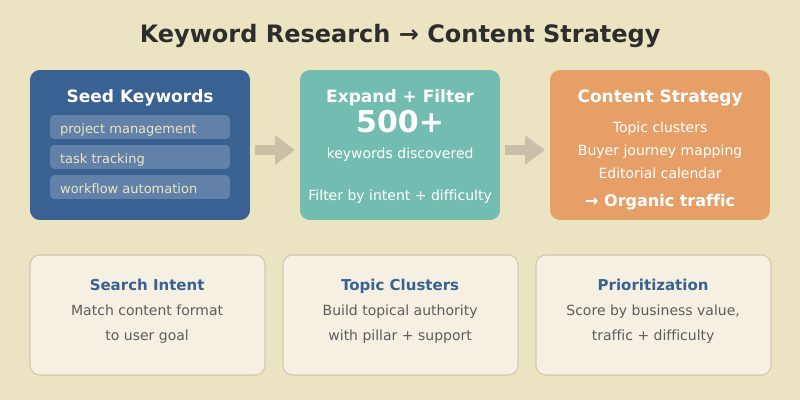
I’ve been doing keyword research professionally since 2015, and the process has evolved dramatically. Today, it’s not just about finding high-volume terms — it’s about understanding user intent, mapping content to the buyer journey, and building topical authority through strategic clustering.
In this guide, I’ll walk you through my complete keyword research process — from finding your first seed keywords to building a full content strategy that drives organic traffic and conversions.
Keyword research is the process of discovering the words and phrases people type into search engines when looking for information, products, or solutions. It’s the bridge between what your audience wants and the content you create.
Here’s why it’s non-negotiable for content success:
Without keyword research, you’re essentially guessing. And in my experience working with dozens of content teams, guessing leads to wasted resources and flat traffic charts. Combining keyword data with traffic analysis gives you the complete picture of what’s working and where to focus next.
Before diving into tools and tactics, you need to understand search intent — the reason behind a search query. Google’s algorithm has become remarkably good at determining intent, and content that mismatches intent simply won’t rank.
| Intent Type | User Goal | Example Queries | Content Format |
|---|---|---|---|
| Informational | Learn something | “what is keyword research” | Guides, tutorials, explainers |
| Navigational | Find specific site/page | “ahrefs login” | Homepage, login pages |
| Commercial | Research before buying | “best keyword research tools” | Comparisons, reviews, lists |
| Transactional | Complete an action | “ahrefs pricing” | Product pages, pricing pages |

When I evaluate a keyword, I always check the current search results first. If Google shows mostly product pages for a term, writing a blog post won’t work — the intent doesn’t match.
The fastest way: Google the keyword and analyze what ranks.
Match your content format to the dominant intent, or you’re fighting an uphill battle.
Every keyword research tool throws numbers at you. Here’s what actually matters:

The average monthly searches for a keyword. Higher isn’t always better — a 50-volume keyword with perfect intent often outperforms a 10,000-volume keyword with mismatched intent.
I typically look for:
An estimate of how hard it is to rank for a term, usually scored 0-100. This metric varies wildly between tools, so use it directionally rather than absolutely.
My general framework:
What advertisers pay for clicks on this keyword. High CPC signals commercial value — people are willing to pay for this traffic because it converts.
A keyword with $15 CPC and 200 monthly searches often beats a $0.50 CPC keyword with 5,000 searches in terms of business value.
Some keywords get lots of searches but few clicks — Google answers them directly in featured snippets or AI overviews. Check if the SERP has:
These features can steal clicks from organic results. Factor this into your prioritization.
You don’t need expensive tools to start, but paid tools save significant time at scale.
Google Search Console — Shows what keywords you already rank for. Essential for finding quick wins and content gaps.
Google Keyword Planner — Free with a Google Ads account. Volume ranges are broad, but useful for initial research.
Google Autocomplete & Related Searches — Type your seed keyword and see what Google suggests. These are real searches people make.
AnswerThePublic — Visualizes questions people ask around a topic. Great for finding informational content ideas.
Ahrefs — My primary tool. Best for keyword difficulty accuracy, content gap analysis, and competitive research. I’ve used it since 2018 and it’s worth every dollar.
SEMrush — Excellent for competitor keyword analysis and tracking. Shows exactly what keywords rivals rank for.
Moz — Good keyword suggestions and SERP analysis. More affordable entry point.
Ubersuggest — Budget-friendly option with decent data. Good for beginners.
For most content teams, one premium tool (Ahrefs or SEMrush) plus free tools covers everything you need.
Seed keywords are the broad topics your business relates to. They’re the starting point for expansion.
Ask yourself:
For a project management software company, seed keywords might be:
Start with 5-10 seed keywords. You’ll expand from there.
Now turn those seeds into hundreds of potential keywords.
Keyword tool suggestions: Enter seed keywords into Ahrefs or SEMrush and export all suggestions. A single seed can generate 1,000+ related terms.
Competitor analysis: Find what keywords competitors rank for that you don’t. In Ahrefs: Site Explorer → enter competitor → Organic Keywords → filter by position 1-20.
Question mining: Use “People Also Ask” boxes, Quora, Reddit, and industry forums to find questions your audience asks.
Modifier expansion: Add common modifiers to seed keywords:
After expansion, you should have 200-500+ keywords to work with.
Not all keywords deserve content. Filter ruthlessly.
For each keyword, assess:
| Factor | Question to Ask |
|---|---|
| Business relevance | Does this relate to what we sell/do? |
| Traffic potential | Is the volume worth the effort? |
| Ranking feasibility | Can we realistically compete? |
| Conversion potential | Will this traffic convert? |
| Content gap | Can we create something better than existing results? |
I score keywords on a simple 1-5 scale for each factor, then prioritize by total score.
Modern SEO rewards topical authority. Instead of isolated posts, organize keywords into clusters around pillar topics.
A topic cluster consists of:
Group your keywords by parent topic. For “keyword research,” clusters might include:
Pillar: Keyword Research (this article)
Each cluster page links back to the pillar. The pillar links out to all cluster pages. This structure signals expertise to Google.

Different keywords serve different stages of the customer journey. Map yours accordingly.

User knows they have a problem but not the solution.
User researches potential solutions.
User ready to choose/buy.
A balanced content strategy covers all stages. Too much awareness content without decision content means traffic that never converts.
You can’t publish everything at once. Prioritize strategically.
I use a simple scoring system:
| Factor | Weight | Scoring |
|---|---|---|
| Business value | 3x | 1-5 based on conversion potential |
| Traffic potential | 2x | 1-5 based on volume |
| Ranking difficulty | 2x | 5=easy, 1=hard (inverted) |
| Content gap | 1x | 1-5 based on opportunity |
Calculate: (Business × 3) + (Traffic × 2) + (Difficulty × 2) + (Gap × 1)
Highest scores = publish first.
Start with keywords where you can rank quickly:
Early wins build momentum and prove the process works.
Keywords alone aren’t a strategy. Here’s how to connect the dots.
Match keywords to optimal content formats:
| Keyword Pattern | Content Type |
|---|---|
| “How to…” | Step-by-step tutorial |
| “What is…” | Definitive guide / explainer |
| “Best…” | Listicle / roundup |
| “X vs Y” | Comparison post |
| “[Product] review” | In-depth review |
| “[Topic] template” | Template + explanation |
Translate prioritized keywords into a publishing schedule:
I recommend planning 1-3 months ahead, with flexibility to adjust based on performance data.
After reviewing hundreds of keyword strategies, these errors appear repeatedly:
Chasing volume over intent
A 10,000-volume keyword means nothing if the intent doesn’t match your content or business model.
Ignoring difficulty
New sites targeting KD 80+ keywords waste months creating content that won’t rank.
One keyword per page thinking
Modern content should target keyword clusters, not single terms. A good article naturally ranks for dozens of related keywords.
Skipping competitor analysis
If you don’t know what’s ranking, you don’t know what to beat. Always analyze the current SERP before writing.
Set and forget
Keywords trends shift. Review and update your keyword strategy quarterly.
Focus on one primary keyword and 2-5 secondary keywords per page. However, well-written content naturally ranks for dozens or hundreds of related terms. Don’t force keywords — write comprehensively about the topic and variations will rank naturally.
Conduct comprehensive keyword research quarterly, with lighter monthly reviews. Trends shift, new opportunities emerge, and competitors change tactics. Your keyword strategy should evolve with the market.
Sometimes yes. Keyword tools often underestimate volume for newer or niche terms. If a keyword has clear intent and business relevance, it may be worth targeting even with “zero” reported volume. Trust your industry knowledge alongside the data.
Neither in isolation. The best keywords balance achievable difficulty with meaningful volume and strong business relevance. A low-difficulty keyword with 100 monthly searches often delivers better ROI than a high-difficulty keyword with 10,000 searches you’ll never rank for.
Typically 3-6 months for new content to rank well. Lower-difficulty keywords may show results in weeks, while competitive terms can take a year or more. Consistent publishing and link building accelerate results.
Effective keyword research is the foundation of every successful content strategy. It transforms guesswork into data-driven decisions, ensuring every piece of content you create has real ranking potential and business value.
The process isn’t complicated: start with seed keywords, expand systematically, filter ruthlessly, organize into clusters, and prioritize by impact. Then execute consistently and measure results.
Whether you’re building a content program from scratch or optimizing an existing one, the principles remain the same. Understand what your audience searches for, create content that matches their intent, and build topical authority through strategic clustering.
Your next step: Open your keyword tool of choice (or start with Google Search Console if you don’t have one). Export your current rankings, identify gaps, and build your first topic cluster. Start with one cluster, execute it well, then expand from there.

Honest reviews of analytics tools, SEO tactics that actually work, and growth strategies for bootstrapped SaaS — no fluff, no affiliate bias.