paid promotion

Content Distribution Strategy: A Channel-by-Channel Playbook

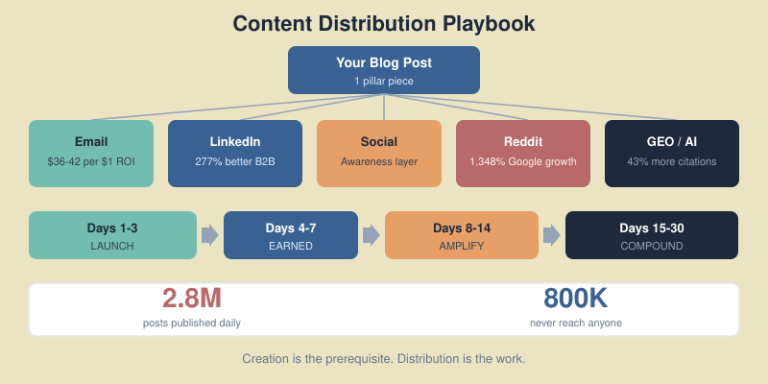
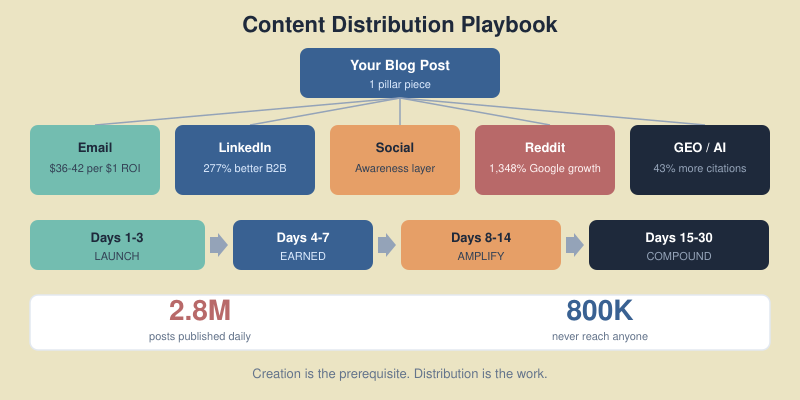
Here’s a stat that should make every content marketer uncomfortable: roughly 2.8 million blog posts go live every single day. And somewhere around 800,000 of them will never be read by anyone beyond the person who hit “Publish.” Not because the content is bad. Because nobody ever saw it.

I call it the “publish and pray” trap. The pattern is always the same: spend 80% of the budget on creation, slap a social share on it, maybe send a newsletter, and wonder why traffic flatlines. The ratio should be reversed. The best-performing content teams I’ve worked with — teams consistently generating six and seven figures in pipeline — treat distribution as the primary job. Creation is the prerequisite. Distribution is the work.

What follows is the playbook I’ve built over 10+ years of running content programs and consulting for SaaS companies. Channel by channel with real benchmarks, a reusable 30-day launch sequence, budget frameworks, and KPIs that actually matter. No theory. No hand-waving. Just the system.

The Three Distribution Layers: Owned, Earned, and Paid

Before we get into individual channels, you need a framework. Every distribution channel falls into one of three layers:

  • Owned channels — You control them. Your email list, your blog, your social profiles, your podcast. You decide when, what, and how content goes out. The trade-off: you’re limited by the audience you’ve already built.
  • Earned channels — Others share your content for you. Organic social shares, backlinks, press mentions, community discussions, influencer amplification. The trade-off: you can’t control it, only influence it.
  • Paid channels — You pay for reach. Social ads, sponsored newsletters, native advertising, content syndication platforms. The trade-off: it costs money, but it’s immediate and scalable.

The mistake most teams make is treating these as separate buckets. They’re not. They’re a system. And when paired with conversion funnel optimization, each layer maps directly to a stage of the buyer journey. Think of it as a stack:

Owned is the foundation. If you don’t have an email list and active social presence, paid and earned channels have nowhere to send people.

Earned is the multiplier. When your content gets picked up by communities or linked by other publications, it multiplies your owned reach without additional cost. But you can’t earn attention you haven’t first seeded through owned channels.

Paid is the accelerant. It amplifies the other two. The smartest paid strategy I’ve used is boosting content that’s already performing organically. You’re pouring fuel on a fire that’s already burning, not trying to ignite wet wood.

When all three work together: a blog post goes to your email list (owned), gets shared by a subscriber who’s an industry voice (earned), and you boost the top social post with $50 (paid). Compounding returns from a single piece.

Distribution stack diagram showing owned, earned, and paid channels layered as a system with owned as the base, earned as the multiplier, and paid as the accelerant

Channel-by-Channel Breakdown (With Real Benchmarks)

Let’s get specific. Here’s what actually works on each channel, what the numbers look like, and where to focus your energy.

Email Newsletters — The Highest-ROI Channel

Email isn’t sexy. It’s also the single most effective distribution channel you have access to. The ROI sits between $36 and $42 for every $1 spent, depending on which study you reference. Nothing else comes close.

There’s a reason 69% of B2B marketers use email newsletters as their primary content distribution channel, according to the Content Marketing Institute. It’s the only channel where you own the relationship completely — no algorithm sitting between you and your audience.

Here’s how I structure email distribution for maximum impact:

  • Segmented sends over batch blasts. Even basic segmentation (topic interest, engagement level, funnel stage) drives 30% more opens and 50% more clicks. I run 3-4 segments minimum.
  • Dedicated content emails vs. roundups. For flagship pieces, send a dedicated email — one topic, one CTA. Save roundups for weekly digests. Dedicated sends outperform roundups by 2-3x on click-through rates in my testing.
  • Re-send to non-openers. 48-72 hours after the initial send, change the subject line, send again. This alone adds 8-12% to your total open rate. Five minutes of work for meaningful lift.
  • Timing matters less than you think. I’ve tested every “best time” recommendation. The honest answer: test and let your data decide. The differences are usually 1-3%, not the 20% some articles claim.

If you do nothing else from this entire article, build your email distribution system first. It’s the foundation everything else amplifies.

LinkedIn — Where B2B Actually Converts

LinkedIn generates leads at a rate 277% higher than Facebook for B2B, and 84% of B2B marketers say it delivers their best organic results. If you’re in B2B and not distributing heavily on LinkedIn, you’re leaving pipeline on the table.

But LinkedIn distribution isn’t “paste your link and write a caption.” The algorithm actively suppresses external links. Here’s what works instead:

  • Native posts outperform link posts by 5-10x on reach. Write a standalone post that delivers value on its own. Put the link in the first comment. Yes, it feels awkward. Yes, it works dramatically better.
  • The comment strategy. Spend 15-20 minutes before and after your post engaging with other people’s content. LinkedIn rewards participants, not broadcasters. I’ve seen posts get 3x the reach just by commenting on 10 other posts in the same hour.
  • Employee amplification. When 5-10 employees engage with a post within the first hour, LinkedIn reads it as high-interest content. At one company I consulted for, employee amplification increased average post reach by 340%.
  • LinkedIn newsletters. With 1,000+ followers, you can launch a LinkedIn newsletter. Subscribers get notified in-app and via email — essentially a second email list with no infrastructure. I’ve seen 40-50% open rates in the first few months.

The key with LinkedIn: consistency beats virality. Posting 3-4 times per week with valuable content will build more pipeline over six months than chasing one viral post.

Organic Social (X, Instagram, Threads) — Awareness, Not Conversion

Let me be direct: organic social on X, Instagram, and Threads is an awareness channel, not a conversion channel. If you’re measuring by clicks to your blog, you’ll be disappointed. If you’re measuring by brand impressions and audience building, it’s valuable.

The engagement benchmarks tell the story. TikTok leads with a 3.70% average engagement rate, Instagram sits at 0.48%, and Facebook trails at 0.15%. X hovers somewhere between Facebook and Instagram depending on your niche.

The “platform-native” rule applies here more than anywhere: content must be shaped for the platform, not reformatted.

  • X: Best for thought leadership, industry commentary, and real-time engagement. Turn key points from your content into standalone insights. Threads (5-10 tweets) that tell a story or walk through a framework consistently outperform single-tweet links.
  • Instagram: Best for visual content — data visualizations, quote cards, carousels breaking down a framework, short-form video. Reels currently get 2-3x the reach of static posts.
  • Threads: Still early, but the engagement rates are promising for text-based content. Think of it as X without the baggage. Good for conversational takes on your content’s core argument.

My rule of thumb: allocate no more than 20% of your distribution time to these platforms unless you’ve built a significant following (>10K) on one of them. The ROI on email and LinkedIn is simply higher for most B2B marketers.

Reddit and Communities — The Underrated Growth Engine

Reddit has seen a 1,348% increase in Google visibility through 2025, and Reddit threads now appear in 97.5% of Google product review queries. When you distribute on Reddit, you’re reaching Google’s audience too.

But Reddit will destroy you if you approach it like a marketer. Here’s how to do it right:

  • Identify 5-10 relevant subreddits. Check the rules — many ban self-promotion. Focus on ones that allow “helpful” links or have weekly promotion threads.
  • Value-first commenting. Spend 2-3 weeks being genuinely helpful before posting your own content. Build karma. When you share, frame it as a resource that answers a question — not “check out my new blog post.”
  • The AMA strategy. If you have genuine expertise, an AMA in a relevant subreddit builds credibility, drives traffic, and creates a permanent piece of content that ranks in Google.

Beyond Reddit, don’t ignore niche communities: Slack groups, Discord servers, indie hacker forums, industry-specific communities. These smaller audiences often convert at 5-10x the rate of broad social platforms because the intent is higher.

Content Syndication and Guest Placement

Syndication means republishing on third-party platforms; guest placement means creating original content for them. Both work, and 50% of B2B marketers use guest posting as a distribution tactic.

  • Medium: Republish your blog posts with a canonical tag pointing back to the original. Medium’s built-in audience can add 10-30% additional readership. Wait 7-14 days after original publication before syndicating to let Google index your version first.
  • Industry publications: Identify 5-10 publications your audience reads. Pitch specific, original angles — not repurposed blog posts. One well-placed guest article in a respected publication can drive more qualified traffic than a month of social posts.
  • Substack cross-posts: If you run a newsletter, cross-posting to Substack gives you access to their recommendation network. I’ve seen creators pick up 200-500 new subscribers per month just from Substack’s discovery features.

The key with syndication is patience. It takes time to build relationships with editors and communities. Start with one or two platforms, do them well, and expand from there.

Paid Amplification — When and How Much

Paid isn’t where you start, but it’s where you scale. Here are the current benchmarks you need to know:

  • Facebook CPM: $7.47 average
  • Instagram CPM: $6.25-$9.46
  • X CPM: ~$5.00
  • Facebook CPC: $0.94-$1.06
  • Instagram CPC: $1.83-$3.35

Here’s when paid actually makes sense:

  • Boost top organic performers. If a post is already getting above-average engagement, paid dollars go further. I never boost content that isn’t already performing — that’s paying to amplify mediocrity.
  • Retarget warm audiences. Serve your best content to recent site visitors. Retargeting CPC is typically 30-50% lower than cold traffic.
  • Promote gated assets. Toolkits, templates, calculators — paid can drive cost-per-lead as low as $3-8 with well-targeted campaigns.

The budget rule for SaaS and B2B: allocate 10-20% of your content budget to paid distribution. Start at 10%, measure ROAS, scale the channels that convert.

GEO — Distributing for AI Search (The 2026 Channel)

Generative Engine Optimization (GEO) is about making your content citable by AI systems — ChatGPT, Google’s AI Overviews, Perplexity, Claude, and whatever launches next quarter. Nobody was talking about this two years ago. By the end of this year, everyone will be optimizing for it.

The numbers are hard to ignore: traditional search volumes are predicted to drop 25% by 2026 as users shift to AI-powered answers. Meanwhile, content optimized with GEO techniques sees 43% higher citation rates in AI-generated responses.

Here’s how to distribute for the AI layer:

  • Structured data everywhere. Schema markup (FAQ, HowTo, Article) helps AI systems parse and cite your content. No structured data means you’re invisible to the emerging discovery layer.
  • Double down on E-E-A-T signals. AI systems preferentially cite sources with strong expertise, experience, authoritativeness, and trustworthiness signals. Author bios, credentials, first-person experience — all increase citation likelihood.
  • FAQ schema for question-based queries. AI assistants pull heavily from FAQ-formatted content. Every major piece should include 3-5 FAQs with schema markup.
  • Create citation-worthy original data. If your content includes original research, surveys, or benchmarks, it’s exponentially more likely to be cited. This is why “state of the industry” reports get referenced endlessly — they’re the only source for specific data points.

GEO isn’t a replacement for traditional SEO or social distribution. It’s a new layer. The teams that build for it now will have a massive compounding advantage as AI search grows.

Benchmark comparison table showing ROI, engagement rates, and cost metrics across email, LinkedIn, organic social, Reddit, syndication, paid, and GEO channels

The Content Atomization Workflow: One Piece, 15+ Assets

Distributing a blog post as-is to every channel is a waste. Atomizing it into 15+ platform-native assets is how you 10x distribution without 10x-ing creation time. Here’s the workflow I use for every pillar piece:

  • Blog post (the source asset)
  • LinkedIn carousel — Pull 5-8 key points, design as a slide deck, post natively
  • Email sequence — Dedicated send for the full piece + 2-3 follow-up emails referencing specific sections
  • X thread — 8-12 tweets walking through the core framework or argument
  • Reddit comments — 3-5 value-add comments in relevant threads linking back to the piece as a resource
  • Short video script — 60-90 second video summarizing the key takeaway for Reels, TikTok, or LinkedIn video
  • Podcast talking points — If you guest on podcasts, turn the content into 3-4 discussion points you can pitch to hosts
  • Infographic — Visualize the data or framework from the piece as a shareable graphic
  • Quote graphics — 3-4 standalone quotes or stats designed for Instagram and LinkedIn
  • Newsletter feature — Adapted version for your newsletter with commentary and personal angle
  • Slide deck — Turn the content into a 10-15 slide presentation for SlideShare or LinkedIn documents
  • Medium republish — Syndicated version with canonical link
  • Community post — Tailored summary for Slack groups or Discord servers
  • Internal brief — Summary for sales team or customer success to reference in conversations

I call this “write once, shape many.” Each format isn’t a copy-paste — it’s a reshaping for the norms of each platform. Here’s the time breakdown:

2 hours — Create the source asset (blog post or pillar content)
3-4 hours — Atomize into platform-specific formats
1 hour — Schedule and queue across channels

That’s 6-7 hours total for 15+ assets from a single idea. Compare that to creating 15 pieces from scratch. You’re not working harder — you’re extracting more value from work already done.

Content atomization workflow diagram showing one blog post being broken into 15 plus distribution assets across email, social, video, community, and syndication channels

The 30-Day Distribution Launch Sequence

This is the section I want you to bookmark. Every piece of pillar content I publish follows this 30-day sequence. It’s the single most impactful system in this entire playbook.

Days 1-3: Launch Phase

  • Day 1: Publish the piece. Send a dedicated email to your most engaged segment. Post on LinkedIn (native format, link in comments). Share on X with a hook thread. Notify your internal team via Slack with a pre-written share template they can use on their own channels.
  • Day 2: Share on secondary social channels (Instagram, Threads). Post in 2-3 relevant Slack or Discord communities (value-first framing). Re-share the LinkedIn post in your story.
  • Day 3: Re-send the email to non-openers with a new subject line. Post a different angle or key stat on LinkedIn. Engage in comments across all platforms.

Days 4-7: Earned Phase

  • Share in 3-5 relevant Reddit threads as a helpful resource (not a promotion).
  • Reach out to 5-10 people mentioned or cited in the piece — let them know and ask if they’d share.
  • Tag relevant influencers or industry voices in social posts highlighting their contributions or perspectives.
  • Submit to any relevant industry newsletters or curated link roundups.

Days 8-14: Amplify Phase

  • Review analytics from the first week. Identify which social posts got the most engagement.
  • Put $25-100 behind the top 1-2 performing posts as paid amplification.
  • Syndicate to Medium, Substack, or other republishing platforms (with canonical tags).
  • Pitch a guest post angle based on the content to 2-3 industry publications.
  • Set up retargeting ads to serve the content to recent website visitors.

Days 15-30: Compound Phase

  • Repurpose into new formats: turn the blog post into a video, create an infographic from the data, build a slide deck.
  • Add internal links from 5-10 existing posts to the new piece (and vice versa).
  • Implement GEO optimization: add FAQ schema, structured data, update meta descriptions for AI citation.
  • Review performance data and document what worked for your next launch cycle.
  • Schedule a “re-share” for 60 and 90 days out on evergreen social channels.

This sequence works because it matches how attention flows. Owned audience generates initial signals. Those signals make earned distribution more effective. By the time you add paid, you know which assets resonate. Most teams stop at Day 3. The compounding happens in weeks 2-4.

30-day content distribution launch sequence timeline showing four phases: Launch on days 1-3, Earned on days 4-7, Amplify on days 8-14, and Compound on days 15-30

Budget Allocation: What to Spend Where

The most common question I get: “how much should we spend on distribution?” Here are the frameworks I use.

The macro budget: SaaS companies typically spend 8-20% of ARR on marketing. Within that, 25-30% should go to content (creation + distribution combined). Early-stage companies skew higher because content is often the most cost-efficient acquisition channel.

Within your content budget, here’s how I allocate:

  • 60% — Creation: Writing, design, video production, editing. This is the raw material.
  • 20% — Distribution: Paid amplification, syndication fees, tool subscriptions (scheduling, analytics, email platform).
  • 10% — Optimization: A/B testing, SEO updates, GEO implementation, content refreshes.
  • 10% — Measurement: Analytics tools, attribution platforms, reporting time.

Now, let’s make this practical for different team sizes:

Team of 1-3: Time is the constraint. Focus 80% of distribution effort on email + LinkedIn + 1-2 communities. Don’t spread across seven platforms — own two or three deeply first. Paid budget: $200-500/month on boosting top organic performers only.

Team of 5+: Run the full 30-day sequence. Assign channel ownership — one person owns email, another social, another communities. Paid budget: $1,000-5,000/month with ROAS tracking. GEO becomes a dedicated workstream.

The universal rule: over-invest early in email, LinkedIn, and communities. These three channels have the highest ROI, the lowest cost, and the most compounding potential. Everything else is a layer on top.

Content budget allocation pie chart showing 60 percent creation, 20 percent distribution, 10 percent optimization, and 10 percent measurement with team-size recommendations

Measuring What Matters: KPIs Per Channel

Here are the KPIs that actually matter per channel — the ones I check weekly, not vanity metrics that look good in reports but don’t drive decisions.

Email:

  • Open rate — Benchmark: 25-35% for well-maintained lists. Below 20% means you have a deliverability or subject line problem.
  • Click-through rate (CTR) — Benchmark: 3-5%. This is the number that tells you if your content is resonating.
  • Conversions from email — Sign-ups, demo requests, purchases attributed to email clicks.
  • List growth rate — Net new subscribers per month. If this is flat or declining, your top-of-funnel has a leak.

LinkedIn:

  • Impressions — How many people saw your content. Tracks reach over time.
  • Engagement rate — (Reactions + comments + shares) / impressions. Benchmark: 2-4% is solid for B2B.
  • Profile visits — Spikes after good posts indicate people want to learn more about you. This is a leading indicator of inbound.
  • Inbound leads — DMs, connection requests with context, or website visits from LinkedIn. The metric that pays the bills.

Paid:

  • Cost per click (CPC) — How efficiently you’re driving traffic.
  • Cost per mille (CPM) — How efficiently you’re generating awareness.
  • Return on ad spend (ROAS) — Revenue generated per dollar spent. If this is below 3:1 for content promotion, reassess your targeting.
  • Cost per lead — For gated content. Benchmark: $5-25 depending on industry and content quality.

Reddit and Communities:

  • Referral traffic — Visits from community links to your site.
  • Time on page — Community-driven visitors typically spend 2-3x longer on page than social traffic. If they don’t, your content isn’t matching the community’s expectations.
  • Brand mentions — Track how often your brand or content gets referenced in discussions you didn’t start.

GEO (AI Search):

  • AI citation rate — How often AI systems reference your content when answering related queries. Tools like Otterly and AI Search Grader are starting to track this.
  • Brand mention frequency — Track mentions across AI platforms using monitoring tools. This is the new “ranking position.”

One primary KPI to rule them all: conversion rate per content piece. 38% of B2B marketers already use this as their primary metric (CMI). It tells you whether content drove action, not just attention. Track it per channel, per format, per topic — and you’ll know exactly where to double down.

KPI dashboard showing key metrics per distribution channel including email open rates, LinkedIn engagement rates, paid ROAS, community referral traffic, and GEO citation rates

Common Distribution Mistakes

I’ve made all of these at some point. Save yourself the wasted months and avoid them:

1. Distributing everything everywhere. A deep technical guide doesn’t belong on Instagram. A quick tip doesn’t need a full email send. Match content type to channel strength or you’ll dilute your effort.

2. Ignoring email for social. I’ve watched teams spend 10 hours/week on social and 30 minutes on email. Email drives 3-5x the CTR and 10x the conversion rate of organic social for most B2B companies. Fix the ratio.

3. One-and-done posting. Your audience didn’t all see it the first time. A single piece should generate 10-20 distribution touchpoints over 30 days, not 3-4. Reshare with different angles, formats, hooks.

4. No channel attribution. If you can’t tell which channel drove a conversion, you can’t allocate smartly. UTM parameters + Google Analytics will get you 80% of the way there.

5. Treating distribution as an afterthought. If your content calendar has “write” dates but no “distribute” dates, you have a creation calendar. Distribution should be planned before the piece is written.

Frequently Asked Questions

How much time should I spend on content distribution vs. creation?

The ideal ratio is roughly 40% creation, 60% distribution. For a 20-hour content week, that means 8 hours writing and 12 hours distributing. Most teams have this inverted. Shift to even 50/50 and you’ll see measurable improvement within 60-90 days. Content doesn’t have to be perfect — it has to be seen.

What’s the best content distribution channel for B2B?

Email, followed by LinkedIn. Email delivers $36-42 ROI per dollar spent with complete relationship control. LinkedIn generates B2B leads at 277% the rate of Facebook. If you can only invest in two channels, these are the two. Add Reddit and niche communities as a third layer once your email and LinkedIn cadence is consistent.

How do I distribute content with no budget?

Focus entirely on owned and earned channels. Build your email list aggressively — even 200 engaged subscribers outperform 5,000 social followers for driving action. Post consistently on LinkedIn with native formats. Participate in 3-5 Reddit communities and industry Slack groups. Repurpose every piece into multiple formats. The 30-day launch sequence in this article costs nothing but time — the first two weeks are entirely free channels.

Should I post the same content on every platform?

No. Use the atomization workflow: reshape core ideas into platform-native formats. The message stays consistent; the packaging changes. A 2,000-word blog post becomes a 10-tweet thread on X, a 5-slide carousel on LinkedIn, a 60-second video on Instagram, and a detailed comment on Reddit. Same ideas, different shapes.

How does AI search change content distribution?

AI search surfaces content through citations in AI-generated responses, not traditional links. With search volumes predicted to drop 25% by 2026, optimizing for AI citation is no longer optional. Implement structured data and FAQ schema, create citation-worthy original data, strengthen E-E-A-T signals, and monitor AI citation rates as a KPI. Content cited by AI systems compounds — the teams investing in GEO now are building a 2-3 year advantage.