Website Traffic Analysis — A Practitioner’s Playbook for 2026
What Web Traffic Analysis Actually Tells You (Beyond Pageviews) Most marketers open their analytics dashboard, glance at pageviews, and move...
What Web Traffic Analysis Actually Tells You (Beyond Pageviews) Most marketers open their analytics dashboard, glance at pageviews, and move...
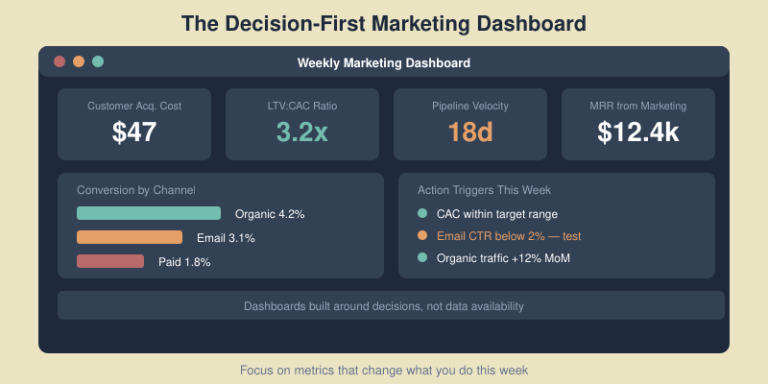
I have built, inherited, and — more often than I care to admit — quietly abandoned more marketing dashboards than...
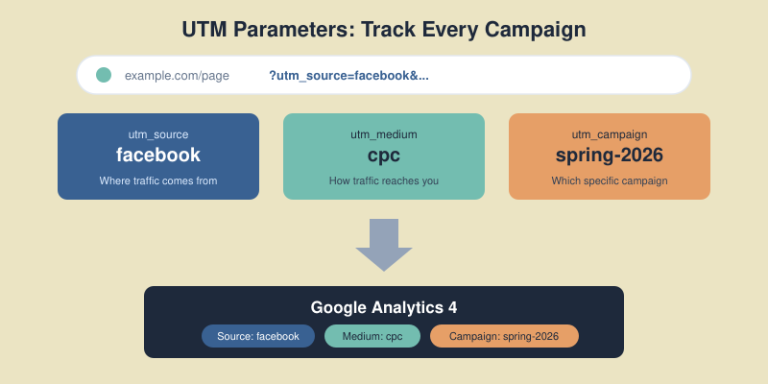
You’re running campaigns across email, social media, paid ads, and partner sites. Traffic is coming in. But when you open...
Most marketers open their analytics dashboard, glance at pageviews, and move on. That’s like checking the odometer on your car without ever looking at the fuel gauge, engine temperature, or speed. You know something happened, but you have no idea what it means.
Web traffic analysis is the practice of collecting, measuring, and interpreting visitor data to make better marketing and product decisions. It answers three questions that actually matter: where are visitors coming from, what are they doing on your site, and why are they leaving without converting?
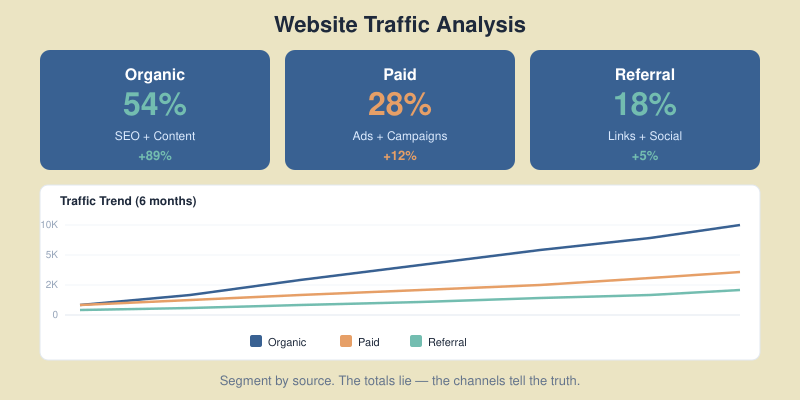
When I started analyzing traffic for my first SaaS client in 2017, I made the classic mistake — I obsessed over total sessions. The number went up every month, but revenue stayed flat. The problem was obvious once I dug deeper: 60% of the traffic came from irrelevant keywords, and the visitors who actually mattered were bouncing from the pricing page. The raw numbers told a success story. The segmented data told the truth.
The difference between reporting traffic and analyzing it is interpretation. Reporting says “we had 50,000 sessions.” Analysis says “organic sessions from bottom-funnel keywords grew 23%, but our paid traffic has a 78% bounce rate on mobile — we’re wasting budget on a broken landing page.”

Not all metrics deserve your attention. After working with dozens of sites across SaaS, content, and ecommerce, I’ve narrowed it down to seven metrics that consistently lead to action — not just observation.
1. Sessions by source/medium. This is your traffic mix. It tells you where growth is coming from and where you’re vulnerable. If 70% of traffic is organic, one algorithm update could cut your pipeline in half. A healthy mix balances organic, direct, referral, and paid channels.
2. Engagement rate. GA4 replaced bounce rate with engagement rate — the percentage of sessions that lasted longer than 10 seconds, had a conversion event, or viewed 2+ pages. This is a far better signal of content quality than the old bounce rate.
3. Conversion rate by source. Not all traffic converts equally. Organic visitors from long-tail keywords often convert at 3-5x the rate of social media traffic. Track this by source to allocate budget where it actually drives revenue.
4. Pages per session. For content sites, this reveals whether your internal linking works. For SaaS, it shows if visitors explore your product pages or leave after the blog post. Anything above 2.0 is a solid baseline.
5. Average session duration. Context matters here. A 45-second session on a pricing page might be perfectly fine — the visitor found the answer. A 45-second session on a 2,000-word guide means they didn’t read it. Always pair duration with page type.
6. New vs returning visitors. A content site should aim for 25-35% returning visitors. Lower means your content isn’t sticky. Higher might mean you’re not attracting new audiences. For SaaS, returning visitors to your product pages are strong buying signals.
7. Exit pages. Forget the homepage — look at which pages people leave from most. If your pricing page has the highest exit rate, that’s where friction lives. If it’s your signup confirmation page, that’s expected. Context separates useful data from noise.

Knowing which metrics matter is half the battle. Here’s the exact workflow I use when I sit down to analyze a site’s traffic — whether it’s for a client audit or my own projects.
Step 1: Start with the big picture (7-day and 30-day trends). Open GA4 and compare the last 30 days to the previous 30. Look for anomalies — traffic spikes, sudden drops, or shifts in source mix. Don’t explain anything yet, just observe.
Step 2: Break down by source/medium. In GA4’s Traffic Acquisition report, sort by sessions. Identify your top 5 sources and check if each one is growing, flat, or declining. Pay special attention to organic — if it dropped, check Google Search Console for indexing issues or ranking changes.
Step 3: Check engagement by landing page. Go to Pages and Screens, sort by sessions, and add engagement rate as a column. Your top 10 landing pages should all have engagement rates above 50%. Anything below 40% is a red flag — the page isn’t delivering what the visitor expected.
Step 4: Follow the money. If you have conversions set up, filter by conversion events. Which sources drive the most conversions? Which landing pages? This is where you stop looking at traffic as a vanity metric and start seeing it as a revenue driver. For campaign-level tracking, proper UTM parameters make this analysis possible.
Step 5: Identify drop-off points. Use GA4’s funnel exploration to map the path from landing page to conversion. Where do visitors leave? A high drop-off between product page and pricing page suggests a value communication problem. Between pricing and signup? Price objection or trust issue.
Step 6: Segment and compare. Never analyze all traffic as one blob. Segment by device (mobile vs desktop often tells wildly different stories), by geography, or by new vs returning users. I once found that a client’s mobile conversion rate was 0.3% versus 4.1% on desktop — the mobile checkout was broken, and nobody had noticed because the overall rate looked “fine.”
Step 7: Document and act. Write down three findings and three actions. Not ten. Not twenty. Three findings, three actions. Track them in your marketing dashboard and revisit next week.

You don’t need expensive website traffic analysis tools to get actionable insights. You need the right combination for your stage and budget. Here are three stacks I’ve used and recommend — from bootstrapped to well-funded.
This covers 80% of what most sites need. Google Analytics 4 handles traffic and behavior data. Google Search Console covers organic search performance — impressions, clicks, average position. Looker Studio connects both into a single dashboard. And Microsoft Clarity adds heatmaps and session recordings for free, with no traffic limits.
The tradeoff: GA4 has a steep learning curve, data sampling kicks in on large sites, and Google owns your data. But for most sites under 500K monthly sessions, this stack works.
Replace or supplement GA4 with a privacy-first platform like Plausible (€9/month) or Fathom (€14/month). These are lightweight, GDPR-compliant by default, and don’t require cookie consent banners — which means you capture 100% of visits instead of only the visitors who click “Accept.” Add Matomo if you need full event tracking and funnel analysis without sending data to third parties.
For competitive intelligence, SimilarWeb‘s free tier gives rough traffic estimates for competitors. Not accurate enough for decisions, but useful for directional benchmarking.
At this level, add dedicated traffic tools for specific jobs. Semrush or Ahrefs for organic traffic analysis and keyword tracking. Hotjar or FullStory for behavioral analytics. Mixpanel or Amplitude for product analytics in SaaS. And a data warehouse (BigQuery) if you need to blend traffic data with revenue data from your CRM.
My honest take: most sites stay at the Growth Stack far longer than they think they need to. Don’t over-tool. Start simple, add when you hit a specific question your current stack can’t answer.
SEO traffic analysis deserves its own section because organic is usually the highest-converting, lowest-cost channel — and the hardest to read correctly.
Start in Google Search Console, not GA4. GSC shows you what happened in Google’s search results before the click: impressions, click-through rate, and average position. GA4 only sees what happens after the click. You need both perspectives.
Here’s what I check weekly:
One pattern I see constantly: sites with strong technical SEO foundations — proper XML sitemaps, clean site architecture, structured data markup — recover faster from algorithm updates. Technical SEO isn’t glamorous, but it’s insurance.
For deeper organic analysis, connect GSC to Looker Studio and build a report that shows organic landing pages alongside their conversion rates from GA4. This tells you which keywords actually drive business, not just traffic.
For your own site, the data lives in your analytics platform. But what if you need to find website traffic data for competitors, potential partners, or market sizing?
Let me be honest about accuracy first. Third-party traffic estimation tools are directionally useful but never precise. In my testing, SimilarWeb’s estimates were within 20-30% of actual traffic for sites above 100K monthly visits — and wildly off for smaller sites. Ahrefs and Semrush are more reliable for organic traffic estimates because they model from keyword ranking data, but they still miss branded search and long-tail variations.
Here’s how I approach competitive traffic research:
For organic traffic estimates: Use Ahrefs’ “Site Explorer” or Semrush’s “Domain Overview.” Look at organic traffic trends over 12+ months, not snapshots. A competitor growing 15% month-over-month in organic traffic is investing heavily in content — pay attention.
For total traffic estimates: SimilarWeb gives the broadest picture — organic, paid, social, referral, and direct. The free version shows top-level numbers. Cross-reference with Ahrefs’ organic estimate to sanity-check.
For content gap analysis: Ahrefs’ “Content Gap” tool shows keywords your competitors rank for that you don’t. This is where traffic analysis turns into strategy — you’re identifying exactly where the opportunity sits.
For market sizing: Combine SimilarWeb data for 5-10 competitors in your niche. Sum their estimated traffic, and you have a rough addressable audience size. Not precise, but good enough for planning your content distribution strategy.

Theory is useful. Practice is better. Here’s a condensed version of a site traffic analytics audit I ran for a B2B SaaS client last quarter — anonymized, but the numbers are real.
The situation: 45,000 monthly sessions, primarily organic (62%). The marketing team was celebrating growth. Revenue from inbound leads was flat for 6 months.
Finding 1: Wrong traffic, right volume. Their top 10 organic landing pages drove 70% of traffic but only 12% of demo requests. The high-traffic pages ranked for informational keywords (“what is X”) while their product-comparison pages — which converted at 8.2% — sat on page 2 of Google.
Finding 2: Mobile was a dead zone. Mobile traffic was 38% of total sessions but accounted for just 4% of conversions. The demo request form required 11 fields and didn’t auto-fill on mobile browsers. Desktop conversion rate: 3.8%. Mobile: 0.4%.
Finding 3: Paid traffic was leaking. Their Google Ads drove 5,200 sessions per month to two landing pages. One converted at 6.1%. The other at 0.9%. Same budget split. Simply reallocating budget to the winning page was the fastest revenue win.
The actions: (1) Rewrote and expanded the product-comparison pages with fresh data and FAQ schema markup to target featured snippets. (2) Reduced the mobile form to 4 fields. (3) Shifted 80% of ad budget to the high-converting landing page. Results after 90 days: demo requests up 41%, cost per lead down 34%.
The point isn’t to share my results — it’s to show that the audit workflow matters more than the tools. GA4, Search Console, and a spreadsheet were all we used.
The analytics landscape has shifted fundamentally. Safari and Firefox block third-party cookies by default. Google Chrome is pushing the Privacy Sandbox. The EU’s ePrivacy regulations keep tightening. If you still rely entirely on cookie-based analytics, you’re probably missing 20-40% of your actual traffic.
Here’s the practical reality in 2026:
Cookie consent affects data completeness. On European sites using GA4 with a consent banner, typically only 55-75% of visitors accept cookies. That means your traffic numbers in GA4 are systematically undercounted. Privacy-first tools like Plausible and Fathom don’t use cookies at all, so they capture every visit — no consent banner needed.
Server-side tracking is becoming the default. Instead of loading a JavaScript tag in the browser (which ad blockers can block), server-side tracking sends data from your server directly to the analytics platform. It’s more reliable, more private, and harder to block. Google Tag Manager supports server-side containers, and Matomo can self-host entirely.
First-party data is king. The shift away from third-party cookies makes your own first-party data more valuable than ever. Email subscribers, logged-in users, CRM data — these are your most reliable data sources. Build your analytics around first-party relationships, not borrowed audiences.
My recommendation for 2026: run GA4 for depth and a cookieless tool (Plausible or Fathom) for accuracy. Compare the numbers monthly. The delta between them is your “consent gap” — and it’s growing every year.
Even experienced marketers fall into these traps. I’ve made every one of them at some point.
Mistake 1: Not filtering internal traffic. If your team visits the site 200 times a day during development or content review, that’s noise in your data. Set up IP filters in GA4 or use the internal traffic identification feature. It takes 2 minutes and saves months of dirty data.
Mistake 2: Ignoring referral spam. Check your referral sources monthly. If you see domains you don’t recognize driving hundreds of sessions with 100% bounce rates, that’s referral spam. Exclude them via GA4 filters.
Mistake 3: Measuring the wrong conversions. A “conversion” in GA4 is whatever you define it as. If your only conversion event is “purchase” but you’re a content site, you’ll think nothing converts. Define micro-conversions: email signups, scroll depth thresholds, content downloads, key SaaS events like trial starts.
Mistake 4: Comparing incomparable time periods. Don’t compare December traffic to January traffic and conclude “traffic dropped.” Seasonality is real. Always compare year-over-year, or at minimum, control for seasonal patterns.
Mistake 5: Chasing vanity metrics. Total pageviews, total sessions, social media followers — these feel good but rarely correlate with revenue. Focus on metrics tied to business outcomes: conversion rate by source, revenue per session, cost per acquisition.
Google Analytics 4 combined with Google Search Console covers most needs. GA4 tracks on-site behavior and conversions, while Search Console shows organic search performance. Add Microsoft Clarity for free heatmaps and session recordings. This stack costs nothing and handles sites up to 500K monthly sessions without data sampling issues.
Check high-level trends weekly — a 10-minute review of source mix, top pages, and conversion rates catches problems early. Do a deep analysis monthly, comparing 30-day periods and investigating anomalies. Run a full audit quarterly, reviewing segments, attribution, and content performance against business goals.
Tools like SimilarWeb, Semrush, and Ahrefs provide directional estimates, not exact numbers. For sites above 100K monthly visits, SimilarWeb is typically within 20-30% of actual traffic. For smaller sites, the margin of error increases significantly. Use them for competitive benchmarking and trend spotting, never for precise planning.
The average engagement rate across industries is 55-65%. Content sites typically see 45-55% (many visitors read one article and leave). SaaS product pages should aim for 65-75%. Ecommerce sites average 55-65%. Anything consistently below 40% on a key landing page signals a mismatch between visitor expectations and page content.
Ideally, both. GA4 offers unmatched depth — funnel analysis, audiences, predictive metrics, and free BigQuery export. Privacy-first tools like Plausible or Fathom capture visitors who decline cookies (typically 25-45% of European audiences), giving you more accurate total counts. Running both gives you depth from GA4 and completeness from the cookieless tool.
I have built, inherited, and — more often than I care to admit — quietly abandoned more marketing dashboards than I can count. After ten-plus years in digital marketing, I can tell you the dirty secret of our industry: most dashboards are decoration. They look impressive in stakeholder meetings, they photograph well for LinkedIn posts, and they do almost nothing to help you make better decisions.
The data backs this up. Research consistently shows that roughly 40% of dashboards are rated 3 out of 5 or lower by their own users. Even more telling, 72% of marketers admit they regularly export dashboard data to Excel just to get the answers they actually need. Think about that for a moment. Nearly three-quarters of us build dashboards and then immediately work around them.
The root problem is not the tools. Looker Studio is powerful. Tableau is gorgeous. Power BI is deeply integrated. The problem is that we build dashboards around data availability rather than decisions. We connect every API we can find, drag every metric onto the canvas, and call it a day. The result is a wall of numbers that impresses nobody and informs even fewer.
This guide is different. I am going to walk you through a framework I have refined across SaaS companies, e-commerce brands, and lean growth teams — one that starts with the decisions you need to make and works backward to the data. It builds on the same principles covered in my website traffic analysis playbook, but extends them into a full dashboard system. If you are a SaaS founder trying to understand where your pipeline actually comes from, a lean marketing team of two or three people who cannot afford to waste hours in spreadsheets, or a growth marketer who needs to prove ROI to a skeptical CFO, this article is for you.
By the end, you will have a repeatable system for building dashboards that people actually open, trust, and act on. No fluff. No “it depends.” Just the framework, the tools, and the step-by-step process.
Before we build anything, we need to understand why dashboards die. In my experience, nearly every failed dashboard falls into one of three archetypes. I call them the Vanity Dashboard, the Frankenstein Dashboard, and the Ghost Dashboard.
This is the dashboard built for show. It is packed with impressive-sounding metrics — total impressions, page views, social followers, email list size — that trend up and to the right but tell you absolutely nothing actionable. I once inherited a dashboard at a B2B SaaS company that proudly displayed “total website sessions: 1.2 million.” Sounds great until you realize the conversion rate was 0.3% and nobody could tell me which channels were actually producing pipeline. The Vanity Dashboard exists to make the marketing team look busy, not to make the company smarter.
This is what happens when every stakeholder gets a say. Sales wants lead source data. The CEO wants revenue attribution. The content team wants engagement metrics. Product wants feature adoption. You end up with a 47-widget monstrosity that takes 90 seconds to load, answers nobody’s specific question, and requires a PhD in data visualization to interpret. The Frankenstein Dashboard tries to be everything to everyone and ends up being useful to no one.
This is the most common failure mode, and the saddest. Someone builds a genuinely thoughtful dashboard, presents it in a team meeting, gets a round of applause — and then nobody ever opens it again. Within three months, the data connections break, the filters go stale, and it becomes a digital artifact. The Ghost Dashboard dies not because it was bad, but because it was not woven into any actual workflow.
The root cause behind all three failures is the same: these dashboards were built around data, not around a decision cadence. Nobody asked “what decisions do we make every week, and what data do we need to make them?” Instead, they asked “what data do we have, and how can we display it?”
That distinction is everything. And it is the foundation of what I call the Decision-First Dashboard framework.

Here is the single most important thing I will tell you in this entire article: do not open your dashboard tool until you have written down the decisions your dashboard needs to support. Grab a notebook, open a blank document, whatever. But do not touch Looker Studio, do not touch Tableau, do not connect a single data source until you complete these three steps.
Not the metrics you track. Not the reports you send. The actual decisions. For most marketing teams, these sound something like: “Should we increase or decrease spend on Google Ads this week?” or “Which content topic should we prioritize next?” or “Is our trial-to-paid conversion healthy enough, or do we need to intervene?” If you cannot articulate the decision, you do not need the metric.
This is where discipline matters. For each decision, identify the single primary metric that most directly informs it. Not three metrics. Not a composite score. One number. You can have supporting context, but there should be one metric that, if you could only see a single number, would let you make a reasonable call.
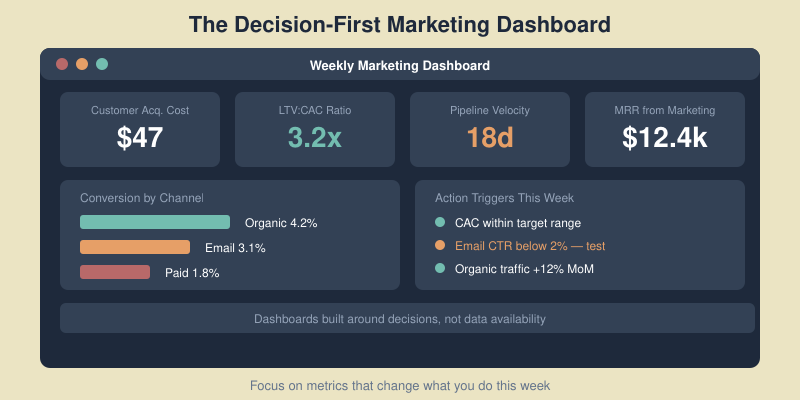
This is what separates a decision-first dashboard from a monitoring dashboard. For each metric, define the specific value or range that triggers a specific action. Not “we will keep an eye on it.” A concrete threshold and a concrete response.
Here is what this looks like in practice for a typical SaaS marketing team:
| Decision | Metric | Source | Threshold | Action |
|---|---|---|---|---|
| Scale or cut paid spend? | Blended CAC | CRM + Ad platforms | CAC > $180 for 2 consecutive weeks | Pause lowest-performing channel |
| Is content driving pipeline? | Content-attributed SQLs | CRM + GA4 | < 15 SQLs per month | Shift 20% of content effort to bottom-funnel |
| Is email nurture working? | Nurture-to-demo rate | Email platform + CRM | < 2.5% conversion | A/B test new nurture sequence |
| Where to allocate next sprint? | Pipeline velocity by channel | CRM | Channel velocity drops 20% MoM | Reallocate resources to top 2 channels |
| Is trial experience healthy? | Trial-to-paid conversion | Product analytics + CRM | < 12% conversion rate | Trigger onboarding optimization sprint |
Notice what is not in that table: impressions, page views, follower counts, open rates as primary metrics. Those may appear as supporting context somewhere on the dashboard, but they are not driving decisions. When you start with this table, your dashboard practically builds itself.

Once you have your decision table, you need to populate it with the right KPIs. This is where most marketers go wrong — they either pick vanity metrics that feel good or they try to track everything and end up with analysis paralysis. I use a simple filter I call the “So What?” test.
For every metric you consider adding to your dashboard, ask yourself: “If this number changed by 20% tomorrow, would I do something different?” If the answer is no, the metric does not belong on your primary dashboard. It might belong in a detailed report or an ad-hoc analysis, but it should not occupy prime real estate on the screen your team looks at every morning.
Page views? So what — unless you can tie them to pipeline. Email open rates? So what — unless a drop triggers a deliverability investigation. Twitter follower count? So what — period.
These are the metrics that pass the “So What?” test for nearly every SaaS company I have worked with:
These metrics are useful for diagnosing why a Tier 1 metric moved, but they should not drive decisions on their own:
My hard rule: no more than 7 to 10 metrics per dashboard. If you need more, you need a second dashboard for a different audience or decision cadence — not a bigger dashboard. Research from Gartner tells us that 87% of executives say data is their organization’s most underused asset. The solution is not more data. It is the right data, in the right context, connected to the right decisions.

Now we get tactical. You have your decision table, you have your KPIs, and you are ready to build. Here is the exact process I follow every time.
Before you pick a tool, inventory where your data actually lives. For most marketing teams, it comes down to four core systems:
Write down every source, the specific metrics you need from each, and whether an API connector exists. This step takes 30 minutes and saves you hours of frustration later.
I am not going to tell you there is one right answer here because it genuinely depends on your budget and technical comfort. Here is my honest breakdown:
For most readers of this blog, I recommend starting with Looker Studio and Sheets. You can always migrate later.
This is the step everyone underestimates. Raw data from different sources does not agree with itself. GA4 will report different conversion numbers than Google Ads, which will differ from your CRM. This is normal and expected — each platform uses different attribution models and tracking methods.
My approach: pick one system of record for each metric type. Use your CRM as the source of truth for pipeline and revenue. Use GA4 as the source of truth for website behavior. Use ad platforms as the source of truth for spend. Do not try to reconcile the differences in your dashboard — just be consistent and document your choices.
Also, invest 30 minutes in UTM hygiene. Standardize your UTM parameters across every channel. Use lowercase. Use consistent naming conventions like utm_source=google and utm_medium=cpc, not sometimes “Google” and sometimes “google-ads.” Broken UTMs are the number one reason attribution dashboards produce garbage data.
Borrow from journalism. The most critical information goes at the top left — that is where eyes land first. Structure your dashboard in three horizontal bands:
Resist the urge to fill every pixel. White space is a feature, not a bug. If your dashboard requires scrolling, it has too much on it.
Not every metric needs real-time data. Match the refresh rate to the decision cadence:
Over-refreshing creates noise and anxiety. Under-refreshing creates blind spots. Match the cadence to how frequently the related decision gets made.

This is the section that separates a genuinely useful dashboard from a pretty picture. I have reviewed hundreds of marketing dashboards over the years, and I can tell you that a dashboard without action thresholds is just a screen with numbers on it. It generates anxiety, not insight.
The Metrics-to-Action Map is a simple document — it can be a table in a Google Doc, a section in your team wiki, or even a note pinned to your dashboard itself — that explicitly connects every key metric to a specific response. Here is what mine looks like for a typical SaaS engagement:
| Metric | Condition | Action | Owner | Timeframe |
|---|---|---|---|---|
| Blended CAC | Exceeds $180 for 2+ consecutive weeks | Pause lowest-ROI channel; reallocate budget to top performer | Paid lead | Within 48 hours |
| LTV:CAC ratio | Drops below 3:1 | Conduct channel-level profitability audit; cut unprofitable segments | Marketing director | Within 1 week |
| Pipeline velocity | Slows by 20%+ month-over-month | Diagnose bottleneck stage; deploy targeted nurture or sales enablement | Growth lead | Within 1 week |
| Trial-to-paid rate | Falls below 12% | Launch onboarding experiment; review activation events with product | Product marketing | Within 2 weeks |
| Content-attributed SQLs | Below 15 per month for 2 months | Shift 30% of editorial calendar to bottom-funnel comparison & use-case content | Content lead | Next sprint |
| Email nurture conversion | Below 2.5% | A/B test subject lines and CTAs; review segmentation logic | Email specialist | Within 1 week |
The magic of this map is that it removes ambiguity. When CAC spikes, you do not schedule a meeting to discuss what to do. You already know what to do, who does it, and how fast. I have seen teams using this approach make decisions up to 5 times faster than teams staring at dashboards and debating interpretation.
Print this map. Tape it to the wall next to your monitor. Reference it in every weekly standup. Over time, your team will internalize the thresholds, and the dashboard becomes a genuine decision engine rather than a reporting obligation.
“The goal is not to have a dashboard. The goal is to have a system where data triggers action without requiring a meeting.”
If you only implement one thing from this entire article, make it this map. Everything else is optimization. This is the foundation.
We cannot talk about dashboards in 2026 without addressing the AI elephant in the room. The good news: AI is not going to replace your dashboard. The better news: it is going to make your dashboard dramatically more useful. I see three practical applications that are ready for production use today — not science fiction, not hype, actual things I am using with clients right now.
Instead of manually scanning your dashboard for problems, set up automated anomaly detection that flags when any metric moves more than 2 or more standard deviations from its rolling average. Most BI tools now support this natively. Power BI has built-in anomaly detection. Looker Studio can achieve this with calculated fields and conditional formatting. The result is that you stop scanning and start being notified — a subtle but enormous shift in how you interact with data.
This one has been a game-changer for me personally. Every Monday morning, an automated workflow exports the previous week’s dashboard data as a CSV, feeds it to an LLM (I use Claude or ChatGPT depending on the client), and generates a plain-English summary: “CAC rose 14% week-over-week, driven primarily by a 22% increase in LinkedIn Ads CPC. Pipeline velocity held steady. Trial-to-paid improved slightly to 13.1%, above threshold.” That summary goes into Slack. Executives love it. It takes the interpretation burden off the marketing team and ensures everyone reads the same narrative.
Feed 6 to 12 months of historical data into a forecasting model, and you can project where your KPIs are heading before they arrive. This is not crystal ball territory — it is basic time-series analysis that AI makes accessible without a data science degree. Tools like Narrative BI, the built-in AI features in Looker Studio and Power BI, and even ChatGPT’s Advanced Data Analysis can generate surprisingly accurate 30 to 60 day forecasts for metrics like MRR, lead volume, and CAC.
The adoption numbers are compelling. According to recent Forrester research, 74% of B2B marketing teams now use some form of AI-powered analytics, reporting an average 23% boost in team productivity and 19% improvement in marketing ROI. These are not marginal gains. If you are not experimenting with AI on top of your dashboard data, you are leaving real performance on the table.
My recommendation for getting started: do not buy a new tool. Take your existing dashboard data, export it as a CSV, and have a conversation with Claude or ChatGPT about what the data is telling you. You will be surprised at the insights a fresh set of (artificial) eyes can surface.

Here is a pattern I see in every company that takes dashboards seriously: they start with one great dashboard, and within 18 months they have 37 dashboards, half of which nobody remembers building and the other half of which show conflicting data. Dashboard sprawl is real, it is insidious, and it undermines the trust you worked so hard to build.
Every dashboard should follow a conscious lifecycle: Build, Adopt, Iterate, Sunset. Yes, sunset. Dashboards should die. If a dashboard has outlived its usefulness, retiring it is not failure — it is hygiene.
Here are my three signals that a dashboard needs to be retired:
I keep dashboard governance simple because complex governance gets ignored:
[Team] - [Decision Area] - [Cadence]. For example: Marketing - Paid Performance - Weekly or Growth - Pipeline Health - Monthly. This sounds bureaucratic, but it makes searching and auditing painless.My ideal dashboard architecture for a marketing team of 5 to 20 people is one executive overview dashboard plus three to four operational dashboards. The executive dashboard shows only Tier 1 KPIs with trend lines and thresholds. Each operational dashboard goes deep on one area: paid acquisition, content and SEO, email and lifecycle, or product-led growth. The executive dashboard links to the operational ones for drill-down. This gives leadership the altitude they need and gives practitioners the detail they need, without either group wading through the other’s view.
Let me be direct about what a well-built dashboard saves you, because I have measured it across multiple engagements.
Time saved: A decision-first dashboard with automated data connections eliminates the manual reporting grind. I have seen teams achieve an 80% reduction in time spent on reporting — going from 8 hours per week pulling and formatting data to under 2 hours reviewing and acting on it. For a team of three marketers billing at $75 per hour, that is over $18,000 per year in recovered productive time.
Faster decisions: When your dashboard is wired to a Metrics-to-Action Map, you stop scheduling meetings to discuss what the data means. You already know. The average decision timeline I have measured drops from 5 to 7 business days (the typical “let’s review this at next week’s meeting” cycle) to 1 to 2 business days.
Reduced ad waste: By surfacing CAC and channel-level performance in near real-time, teams catch underperforming campaigns days earlier. On a $20,000 per month ad budget, catching a broken campaign or audience fatigue even 3 days earlier can save $2,000 to $3,000 per month in wasted spend.
The free option pays for itself immediately. Even if you go with Google Looker Studio at $0 in software costs and invest 8 hours of setup time, you will recoup that investment in the first month through time savings alone. There is genuinely no excuse not to start.
But the biggest ROI is one that does not show up in a spreadsheet: alignment. When everyone on the team — marketing, sales, product, the CEO — looks at the same dashboard and shares the same definitions of success, you eliminate an enormous amount of organizational friction. No more “my numbers say something different” conversations. No more attribution debates. One source of truth, one shared understanding, one direction.

Google Looker Studio (formerly Data Studio) is the best free option for most marketing teams, and it is not even close. It connects natively to GA4, Google Ads, Google Sheets, and BigQuery, and there are free community connectors for platforms like Facebook Ads, HubSpot, and Mailchimp. Pair it with Google Sheets as an intermediary data layer — pulling data from your various platforms into Sheets via add-ons or simple Apps Script automations, then connecting Sheets to Looker Studio — and you have a surprisingly robust setup. I have built dashboards with this stack for companies doing $10 million or more in annual revenue. The main limitation is that it lacks advanced statistical features and can be slow with very large datasets, but for 90% of marketing teams, it is more than enough.
I recommend a hard maximum of 7 to 10 metrics per dashboard view. This is not an arbitrary number — it aligns with cognitive load research showing that humans can effectively process and compare roughly 7 pieces of information at once. Your primary dashboard should feature 3 to 5 Tier 1 KPIs that directly inform decisions, supported by 3 to 5 Tier 2 metrics that provide diagnostic context. If you find yourself needing more than 10 metrics, that is a signal that you are trying to serve multiple audiences or decision cadences with a single dashboard. Split it into an executive overview and one or more operational dashboards instead of cramming everything onto one screen.
Match the refresh cadence to the decision cadence, not to your anxiety level. For most marketing teams, a daily refresh of campaign-level metrics (spend, leads, conversion rates) and a weekly refresh of strategic KPIs (CAC, pipeline velocity, MRR attribution) works well. Real-time or hourly refreshes should be reserved for specific scenarios like monitoring a product launch, a flash sale, or heavy campaign spend days where you need budget pacing visibility. In practice, I find that most teams check their dashboard twice: once at the start of the day for a quick pulse, and once during a weekly team review for deeper analysis. Set your refresh cadence to support those two moments, and you will be well served.
Absolutely, and I would argue that you should. The most effective dashboards I have seen were built by the marketers who use them, not by analysts working from a requirements doc. Modern tools like Looker Studio, Databox, and HubSpot’s dashboard builder are designed for non-technical users. The Decision-First Framework I outlined above does not require any SQL, Python, or data engineering skills — it requires clarity about your decisions and the discipline to keep things simple. Where a data analyst becomes valuable is when you need to connect complex data sources, build custom attribution models, or do advanced statistical analysis. But for a standard marketing performance dashboard? You have everything you need. Start with Looker Studio and Google Sheets, follow the steps in this guide, and you will have a working dashboard in a single afternoon.
A dashboard is a living, continuously updated view of your current state — think of it as a car’s instrument panel. It answers “where are we right now?” and “do we need to act?” A report is a point-in-time analysis that answers “what happened, why, and what should we do next?” Reports are narrative. They include interpretation, context, and recommendations. Dashboards are visual. They surface patterns and anomalies at a glance. You need both, but they serve different purposes. A common mistake is trying to turn a dashboard into a report by adding too much text and explanation, or trying to turn a report into a dashboard by stripping out the analysis. Let your dashboard handle the monitoring and alerting. Let your reports (weekly, monthly, or quarterly) handle the storytelling and strategic recommendations. The best marketing teams use dashboards daily and reports weekly or monthly, with the dashboard data feeding directly into the report narrative.
You’re running campaigns across email, social media, paid ads, and partner sites. Traffic is coming in. But when you open Google Analytics, everything’s lumped under “direct” or “referral” — and you have no idea which campaign actually drove those conversions.
This is the reality for marketers who skip UTM parameters. And it’s completely avoidable.
I’ve been setting up tracking systems for marketing teams since 2016, and UTM parameters remain one of the most powerful yet underutilized tools in the analytics stack. When implemented correctly, they give you crystal-clear attribution data. When done poorly — or not at all — you’re making decisions based on incomplete information.
In this guide, I’ll show you exactly how to use UTM parameters to track every campaign with precision, avoid common mistakes that corrupt your data, and build a system that scales with your marketing efforts.
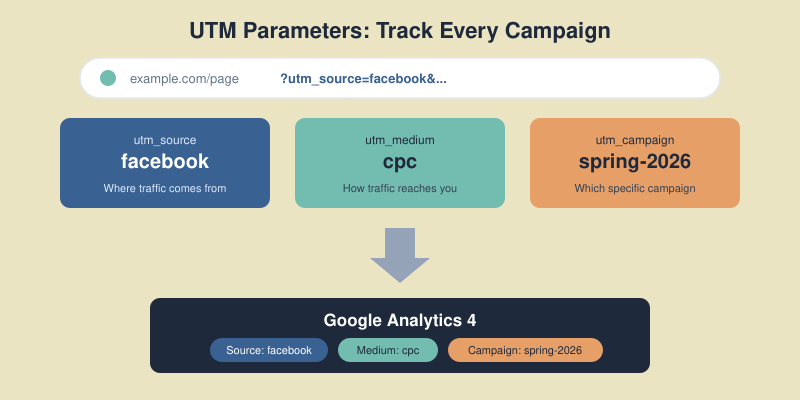
UTM parameters (Urchin Tracking Module) are tags you add to URLs that tell analytics tools where traffic came from. When someone clicks a link with UTM parameters, that information gets passed to Google Analytics, allowing you to see exactly which campaigns, channels, and content drove the visit.
A URL with UTM parameters looks like this:
https://example.com/landing-page?utm_source=facebook&utm_medium=paid&utm_campaign=spring-sale-2026
Without these tags, GA4 often misclassifies traffic — email campaigns show up as “direct,” social posts get lumped into “referral,” and you lose visibility into what’s actually working.
UTM parameters solve three critical problems:
In my experience, teams that implement proper UTM tracking typically discover that 20-30% of their website traffic was being misattributed. That’s a significant blind spot when making budget decisions.
There are five standard UTM parameters. Three are essential, two are optional but useful for specific use cases.

utm_source — Where the traffic comes from
This identifies the platform, website, or vendor sending traffic. Be specific but consistent.
google, facebook, newsletter, linkedin, partner-siteutm_medium — How the traffic reaches you
This describes the marketing channel or mechanism. Use standardized values that match GA4’s default channel groupings when possible.
cpc, email, social, affiliate, display, organicutm_campaign — Which specific campaign
This identifies the specific promotion, product launch, or marketing initiative.
spring-sale-2026, product-launch-q1, webinar-seo-basicsutm_term — Keyword targeting (mainly for paid search)
Originally designed for paid search keywords. Use it to track which terms triggered the ad click.
running+shoes, project+management+softwareutm_content — Content differentiation
Use this to distinguish between different links pointing to the same URL — like A/B testing ad creatives or tracking multiple links in the same email.
hero-button, sidebar-link, blue-cta, version-aThe most common UTM mistake isn’t forgetting to use them — it’s using them inconsistently. “Facebook,” “facebook,” “fb,” and “FB” all create separate line items in GA4, fragmenting your data and making analysis nearly impossible.

Always use lowercase — UTM parameters are case-sensitive. Email and email create separate entries. Pick lowercase and stick with it.
Use hyphens instead of spaces — Spaces get encoded as %20 in URLs, making them ugly and harder to read in reports. Use hyphens: spring-sale not spring%20sale.
Avoid special characters — Stick to letters, numbers, and hyphens. Special characters can break tracking or cause encoding issues.
Be descriptive but concise — email is better than e, but monthly-newsletter-subscriber-list-segment-a is overkill. Find the balance.
Standardize values across teams — Create a documented list of approved values. If your paid team uses cpc and your social team uses paid-social, your reports become fragmented.
| Parameter | Recommended Values |
|---|---|
| utm_medium | cpc, email, social, affiliate, display, referral, organic, video |
| utm_source | google, facebook, instagram, linkedin, twitter, newsletter, partner-name |
These align with GA4’s default channel groupings, making your reports cleaner and more actionable.
The utm_campaign parameter is where most teams struggle. It’s a free-form field, which means it’s easy to create chaos. Here’s how to structure it properly.
A good campaign name answers: What is this? When did it run? What’s it promoting?
I recommend this structure:
[type]-[name]-[date/identifier]
Examples:
promo-spring-sale-2026q1launch-new-feature-jan2026webinar-seo-fundamentals-20260115newsletter-weekly-w03You’ll run similar campaigns multiple times — monthly newsletters, seasonal sales, weekly promotions. Including dates lets you compare performance over time.
Without dates, your January newsletter data mixes with December’s, making trend analysis impossible.
Campaign names should be understandable at a glance. When you’re reviewing reports months later, promo-blackfriday-2026 tells you exactly what you’re looking at. bf26promo1 requires mental translation.
You can build UTM URLs manually, but I don’t recommend it for teams. Manual creation leads to typos and inconsistency.
Google offers a free Campaign URL Builder that generates properly formatted URLs. It’s simple but doesn’t enforce naming conventions.
For teams, I prefer spreadsheet-based UTM builders. They offer:
Create a Google Sheet with columns for each parameter, use data validation for standardized dropdowns, and add a formula column that concatenates everything into the final URL.
For larger teams, tools like UTM.io, Terminus, or Bitly offer advanced features: team governance, link shortening, and integration with marketing platforms.
Different channels have different tracking needs. Here’s how to approach each.

Email is frequently misattributed as “direct” traffic. Always tag email links.
| Parameter | Value |
|---|---|
| utm_source | newsletter (or specific list name) |
| utm_medium | |
| utm_campaign | campaign-name-date |
| utm_content | header-link, cta-button, footer-link |
Use utm_content to track which links in the email get clicked most. This data helps optimize email layout.
Organic social posts need UTMs — otherwise they often show as referral traffic without campaign context.
| Parameter | Value |
|---|---|
| utm_source | facebook, linkedin, twitter, instagram |
| utm_medium | social |
| utm_campaign | specific campaign or content-type |
Most ad platforms (Google Ads, Meta Ads) have auto-tagging features. Use those when available — they provide more detailed data than manual UTMs.
For platforms without auto-tagging, or when you need custom tracking:
| Parameter | Value |
|---|---|
| utm_source | platform name |
| utm_medium | cpc, display, video (match the ad type) |
| utm_campaign | campaign name from ad platform |
| utm_term | targeted keywords |
| utm_content | ad creative identifier |
Track traffic from partners to understand which relationships drive value.
| Parameter | Value |
|---|---|
| utm_source | partner-name |
| utm_medium | affiliate or referral |
| utm_campaign | partnership type or promo |
I’ve audited dozens of UTM implementations. These mistakes appear repeatedly.

This is the most damaging mistake. Adding UTM parameters to links within your own website overwrites the original traffic source, creates false sessions, and corrupts your attribution data.
If someone arrives from a Facebook ad, then clicks an internal link with UTMs, GA4 now thinks they came from wherever that internal UTM pointed. You’ve lost the true source.
Rule: UTMs are for external links pointing TO your site, never for links WITHIN your site. Use GA4 events or custom dimensions for internal tracking.
As mentioned earlier: Facebook, facebook, and FACEBOOK are three different sources in GA4. Pick one format (lowercase) and enforce it.
Email and organic social are the most commonly untagged channels. Without UTMs, email often appears as direct traffic, and social posts show as generic referrals. Always tag these channels.
I’ve seen campaign names like 2026_q1_email_newsletter_segment-a_version-2_test-subject-line-b. This creates analysis paralysis. Keep names informative but manageable.
Without documentation, teams drift into inconsistency. Create a UTM governance document that specifies:
Once your UTMs are in place, here’s how to analyze the data in GA4.

Navigate to: Reports → Acquisition → Traffic acquisition
This shows session-level data. Key dimensions to use:
Navigate to: Reports → Acquisition → User acquisition
This shows how users first discovered your site — useful for understanding which channels bring in new audiences.
For deeper analysis, use GA4’s Explore feature to build custom reports combining UTM dimensions with your conversion metrics. This lets you answer questions like:
Once you’ve mastered the basics, these advanced techniques add more value.
Ad platforms support dynamic parameters that auto-populate based on the ad. For example, in Google Ads:
utm_campaign={campaignid}&utm_content={creative}
This automatically inserts the campaign ID and creative ID, ensuring accuracy without manual entry.
Use UTMs on QR codes for print materials, event signage, and physical promotions. Create unique campaign names for each placement to track which offline touchpoints drive traffic.
Long UTM URLs look suspicious and can deter clicks. Use link shorteners like Bitly, Rebrandly, or your own branded short domain. The UTM data still gets captured — the shortened link just redirects to the full URL.
Review your UTM data monthly. Look for:
Clean data requires ongoing maintenance.
No, UTM parameters don’t affect SEO rankings. Google ignores UTM parameters when evaluating page content. However, don’t use UTMs on internal links — that causes analytics issues, not SEO issues.
Google Ads auto-tagging (GCLID) provides more detailed data than manual UTMs. Use auto-tagging for Google Ads. Manual UTMs are better for platforms without auto-tagging or when you need custom campaign tracking.
There’s no strict limit, but keep URLs under 2,000 characters total for maximum compatibility. More importantly, keep parameter values concise and readable — they should be understandable in reports.
No, once a link is shared, changing it requires sharing a new link. This is why planning and consistency upfront matters. Document your UTM strategy before launching campaigns.
Source identifies WHERE traffic comes from (facebook, google, newsletter). Medium identifies HOW it reaches you (cpc, email, social). Think of source as the specific platform and medium as the channel type.
Proper UTM parameters transform your marketing analytics from guesswork into precision. You’ll know exactly which campaigns drive traffic, which channels deliver ROI, and where to focus your budget.
The implementation isn’t complicated: establish naming conventions, document approved values, use a URL builder, and never tag internal links. The discipline of consistent UTM usage pays dividends every time you make a marketing decision.
Start simple. Tag your email campaigns and social posts first — these are the most commonly misattributed channels. Build your UTM spreadsheet, train your team on the conventions, and review your data monthly.
Your next step: Create a UTM naming convention document for your team. Define your approved values for source, medium, and campaign naming structure. Then tag your next campaign properly and watch the clean data flow into GA4.

Honest reviews of analytics tools, SEO tactics that actually work, and growth strategies for bootstrapped SaaS — no fluff, no affiliate bias.